Monday, May 22, 2023

Review: Doctor Who: Adventures in Time and Space

Doctor Who: Adventures in Time and Space
The first decade of the 2000s gave us a new series of Doctor Who starting in 2005. The 9th Doctor, played by Christopher Eccleston, was, in his own favorite word, fantastic. He re-introduced the character to both new and old audiences. It can be argued that the show, and new fandom, really took off with David Tennent's 10th Doctor. In 2009 British RPG publisher Cubicle 7 released its first Doctor Who game. Like the show it was based on, it was a huge success.

A couple of points I want to clarify first.

I am reviewing my boxed set here AND the PDF from DriveThruRPG. There will be differences, so I will point these out.

I was on the playtest for this game as I have mentioned in the past. Plus Dave Chapman and a fe of the Cubicle 7 guys were also play testers for my Ghosts of Albion game. We communicated often in the time Doctor Who, Ghosts, and Chapman's other RPG Conspiracy X was being developed by Eden Studios. 

Doctor Who: Adventures in Time and Space

262+ pages. Full-color interior and covers. Print: soft-cover books in a boxed set. Digital: Seven PDFs in a Zip file.

This is the first of many printings of the C7 Doctor Who game. A good way to differentiate from one to the other is by which Doctor appears on the cover. This is the Tenth Doctor's cover.

The Boxed set features two softcover books; a Player's Guide and a Gamemaster's Guide. Several cardboard "story point" tokens, a "Read Me First" booklet, several character sheets, and gadget sheets. All of these are also present in PDF form. The Boxed set additionally has a set of six d6 dice to use in the game. The dice are also available separately.

Doctor Who RPG Box CoverDoctor Who RPG Box Cover

Player's and Gamemaster's Books

Read This First - How To Play

This four-page booklet covers the really basic basics. It is written with the Doctor Who fan in mind and not the average role-player. So we cover questions like "where is the board?" and "how do I play?"

Inside the 10th Doctor's character sheet is broken down. It is recommended that starting players use one of the pre-made characters in the box, but there is nothing saying you can't use your own characters. 

The "Basic Rule" is covered here. 

            Attribute + Skill (+Trait) + 2d6 = Result; Compare result to a Task Difficulty.

That is the guiding principle for the entire game and it works really, really well.  Your average Difficulty is 12 but it can be as low a 3 (super easy) or 30+ (near impossible). Contested rolls are introduced and the all-important Story Points (the little cardboard counters).

You are directed next to the Adventures Book.

Adventures Book (and Characters)

This is a 32-page book of easy to start with adventures. They include "Arrowdown" with some monster form Autons (very clever), "Judoom" a short adventure inside a Judoon cruiser, and a bunch of adventure seeds to give you some starting points. All the rules needed to run these adventures are self-contained. 

For these adventures, it is recommended that you use the provided characters. These include The 10th Doctor, K-9, Sarah Jane Smith, Rose Tyler, Martha Jones, Donna Noble, Mikey Smith, and Capt. Jack Harkness. Additionally, there are some "pre-gens" for players to customize on their own. These include a Medical Doctor, a Musician, a Student, a UNIT Soldier, a Torchwood Operative, a Scientist/Inventor, and a Journalist. There are also six blank character sheets for your own creations.  The "named" sheets are printed on slightly heavier stock than the pre-gens or the blank sheets.  

There are also gadget sheets, both filled out and blank.

Character Sheets

Character Sheets

Character Sheets

Gadget Sheets

Doctor Who RPG the Player's Guide
The Player's Guide

These are the rules of the game proper. This is a 86-page soft-cover perfect bound book. Mine is getting on so the binding is coming loose, but nothing that I didn't expect for a book that is nearly 14 years old (which is old for a Sontaran!). 

Chapter One: The Trip of a Lifetime

This chapter begins with some set-up fiction. Only two pages. We get another recap on the basics; Who is the Doctor, what is roleplaying, what is a Gamemaster, and the like. As well as how to use this book in the game.

This chapter sets up the game rather well. Imagine going anywhere, anytime, past, present, or future. 

Chapter Two: The Children of Time

This covers the characters of the game. From playing your own to games with no Time Lords at all! We start with detailing the Attributes of the character, or the qualities of a character that are typically fixed. These are Awareness, Coordination, Ingenuity, Presence, Resolve, and Strength. Similar to the "Basic 6" of many RPGs.  All these are scored from 1 to 6 with 1 being the human minimum, 6 the human maximum, and 3 being the average. Time Lords and other aliens can go beyond these.  These are bought on a point-buy system.

Traits are the qualities of a character, good or ill. There are Minor Traits (Animal Friendship, Attractive), Major Traits (Boffin, Fast Healing), and Special Traits (Alien, Cyborg, Time Lord). Like Attributes, you spend Character Points to buy these. Some can be good or bad traits, and some can be Minor, Major or Special depending on how they are "bought" in character creation. "Friends" can be minor or major depending on the friend in question. "Hypnosis" can be minor, major or special depending on how powerful it is. 

Skills are also purchased with Points. There are only 12 skills, unlike modern D&D and more like Unisystem, skills can be combined with any attribute as appropriate. 

Chapter Three: Allons-y!

This takes us back to our basic rule and expands on it. It gives us some details on the Task Difficulties; 3 for Really, Really Easy, 12 for Average, and 30 for Nearly Impossible. Additionally, there are thresholds if you roll above or below the set difficulty levels. So, for example, if you score 9 points above the roll needed, something special can happen, like extra damage or something.  Likewise, if you roll poorly, something bad can happen.

The rolls, much like in Unisystem, become easier with practice, and soon you won't need any guides at all. 

Contested rolls, rolls where your character is being prevented from success are also covered. The biggest example of this is combat.  Example situations are given and which skills can or should be used. This is a good way to rule these since Doctor Who is not really about combat. "Combat with words" is more important and can even stop physical combat. Though there are weapons detailed here and how deadly they are. Afterall no one can talk a Dalek out of being a Dalek. 

Chapter Four: Two Worlds Will Collide

This covers the ins and outs of good Roleplaying. There is also another character sheet here to copy (print) or print out (pdf).

Doctor Who RPG the Gamemaster's Guide
The Gamemaster's Guide

This book is for the Gamemasters naturally. Not that Players can't read it. This book is also a full-color, perfect-bound softcover book. It is 140 pages.

The first four chapters here parallel the four chapters of the Player's book. 

Chapter One: Next Stop, Everywhere!

A brief recap of the basics and what this book is for.

Chapter Two: The Stuff of Legend

Covers character creation from a Gamemaster point of view. This includes different types of groups (Doctor and Companions, Unit or Torchwood Groups, and more). We also get some details on how the various Attributes work with examples of seven levels (1-6 for humans, 7+ for others). 

Traits are likewise discussed since they provide the most differences between characters and character types. All the traits are covered again, but in briefer, "rules only" formats. Same with skills.

We also get some "Technology Levels" TL. I will have to go back and see how well these map onto other RPGs, in particular the FASA Doctor Who and Traveller. For the record Earth of Doctor Who is TL 5, we are closer to TL 4.75 I think.

Chapter Three: The Long Game

Covers running a game. This includes when to roll (and when not too) and how to judge rolls and difficulty levels.  While not a combat-focused game there is lot of text dedicated to it since that is the place where rolls will happen the most. 

We get a section on using and regaining Story Points and experience. 

Some equipment is also covered here. 

Chapter Four: A Big Ball of Timey-Whimey Stuff

Covers not just roleplaying, but roleplaying in Time Travel games. Here we get a lot of advice on how, well, to keep gamers from being gamers and avoiding paradoxes. 

We get some background on Time Lords and TARDISes. Not encyclopedic details mind you, but enough to keep players and gamemasters happy. 

Chapter Five: All the Strange, Strange Creatures

Ahh. Here is our chapter on all the Aliens. While some are certainly foes to be fought (Daleks, Cybermen) there is a lot here that run the spectrum of friend to fiend.  Creatures use the same stats as characters. So it is expected that there are some "Alien Traits" here as well. These work just like Character Traits, but are typically not bought by characters. 

Chapter Six: You Are Not Alone

This covers the role of the Gamemaster and what they do in the game. There are some resources shared here for gamemaster including other Doctor Who books out at that time. 

Chapter Seven: The Oncoming Storm

This chapter covers running adventures. This includes where (and when) to set them and a basic 5-act adventure formula. Other tips and tricks covered are personal story arcs (thin Donna or Clara), cliffhangers, two (or three) part stories, and more.

It is a great starting point for all GMs.

Doctor Who: Adventures in Time and Space really is a wonderful game and the best Doctor Who game to date. It is easy to see why it has had such staying power. The rules are simple, easy to understand, but infinitely flexible. They emulate the genre very well and can be used to in a variety of situations. 

The rule system is such that it could be powering other games as well.  It did, for a while, with games like Primeval (no longer available) but I am not sure if it is used elsewhere now. 

Honestly, it is one of my favorite games.

#Dungeon23 Tomb of the Vampire Queen, Level 5, Room 22

 The next room on the left also appears to be some sort of quarters.

Room 22

In this room is its former and current inhabitant.  An Ancient Ophidian Mummy.

This mummy is ancient, really ancient. The necromantic forces that are natural to this area affected this ophidian officer. He is powerful but quite insane. In this room, he is powerful (8 HD) but once he leaves he drops to 5 HD, if he leaves the ship he drops to 3 HD. So for the last few centuries he has been sulking here.

As an Ophidian Mummy, he does not have the Mummy disease as do standard mummies, but he does have a poisonous bite. It causes 1d4 hp damage, but victims have to save vs. Death or take 4d8 hp damage (save for half).


Sunday, May 21, 2023

#Dungeon23 Tomb of the Vampire Queen, Level 5, Room 21

 Going back to the corridor, taking the last remaining hallway, this one is wider and longer. 

There are doors on the left-hand side and a door at the end of the hall. 

Room 21

The first door on the left is room 21. These appear to be more sleeping quarters, but only one bed per and they seem to have more amenities. 

Within this room is another "heat wand" with 1d6+1 charges.  If one of the lighted "tables" (panels) is touched a voice speaking in ophidian will come over speakers. The recording is just an officer's log, but it sounds sinister to the character's ears; like some sort of spell or incantation. They will not be able to translate it, magic won't work on this.


Saturday, May 20, 2023

#Dungeon23 Tomb of the Vampire Queen, Level 5, Room 20

 This series of rooms follow after the previous 8. They are modified, but still appear to be barracks or sleeping quarters of some sort.

Room 20

There are 8 (a to h) rooms here. These rooms each have 4 beds. 

20a-d: Empty. Various nicknacks of silver to amount to 6 gp value in each room.
20e: Dead (skeleton) Ophidian
20f: Dead (mummified) Ophidian
20g: Empty, no tresure
20h: Empty, but there is a curious device here. It looks like a metal wand about 10" long. One end is open and a red crystal can be seen inside. There is a small depression near the middle. If press a ray of heat will shoot out causing 1d6+1 damage (Death Ray save for half) to a distance of 50'.

The wand has 1d6+4 charges remaining.

--

The wand is a heat ray, but a weak one. Damage to an Ophidian would only be 1d4+1. 

Friday, May 19, 2023

Kickstart Your Weekend: Flashback to 1983!

We have a bunch of new Kickstarters this week to make you feel like you are back in 1983. So let's get going.

The Mosidian Temple: an OSRIC/1E Adventure

The Mosidian Temple: an OSRIC/1E Adventure

https://www.kickstarter.com/projects/dlimedia/the-mosidian-temple-an-osric-1e-adventure?ref=theotherside

A chance find by author David Flor and DarkLight Interactive will bring this 40 year old treasure to life.

Already funded, they are now headed into the stretch goals. This one will be an absolute treat to see.

Now I have said you can never have too many Monster books, so here are two more!

Devilry For Old-School Essentials

Devilry For Old-School Essentials

https://www.kickstarter.com/projects/gamersandgrognards/devilry-for-old-school-essentials?ref=theotherside

This is a companion piece to the Demon book they Kickstarted last year.  For OSE, it will give us a bunch of devils. So you know I am already all over it.

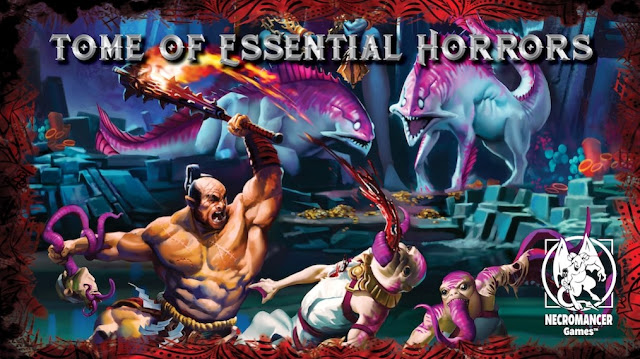
Tome of Essential Horrors

Tome of Essential Horrors

https://www.kickstarter.com/projects/necromancergames/tome-of-essential-horrors?ref=theotherside

Necromancer Games is back and this time with another update to their Tome of Horrors line. This time for OSE.  I am expecting some overlap with this and the Devilry book above and that is OK in my mind.

I rather liked all the Tome of Horrors books and have them all.


#Dungeon23 Tomb of the Vampire Queen, Level 5, Room 19

 Going back to the central corridor and now taking the middle passageway on the right it leads to a series of rooms.

Room 19

There are 8 (a to h) rooms here. These rooms each have 4 beds. 

Room 19a: Four dead bodies. These bodies are more mummified and can be seen for what they are, snake people.
Room 19b, 19c: Empty
Room 19d: This room is home to an Ophidian Spectre. The Spectre attacks anyone who comes in.
Room 19e, 19f: Empty
Room 19g: Two mummified bodies
Room 19h: Two mummified bodies and 1 Ophidian Zombie. The Zombie attacks.

--

There are no treasures in these rooms. All the items are made of plastic or other synthetic materials.

Thursday, May 18, 2023

Doctor Who: Adventures in Time and Space from Cubicle 7

 I am now coming up on the next wave of Doctor Who RPGs. All from Cubicle 7

Doctor Who RPGs

While there are technically three RPGs, they are all related.

First is the Doctor Who: Adventures in Time and Space. This is the one I have talked about here a lot already.

Second is the new Second Edition of the RPG, now just The Doctor Who Roleplaying Game.

And finally, we have Doctors & Daleks, a game based on the previous two, but using the 5th Edition Dungeons & Dragons OGC rules.

One thing that strikes me is despite all I have said about this game line over the years I have never really given it a proper full review.  Well I will change that next week.

In the meantime, here are some characters I have stated up for the Doctor Who RPG (1st Edition so far).

I'll spend the rest of May with this system.

#Dungeon23 Tomb of the Vampire Queen, Level 5, Room 18

 One of the "bed rooms" (Room #17) has a larger open corridor that leads to another similar room. This room however only has one bed in the very center.  

Room 18

Pressing any buttons will cause different colored lights to shine with an accompanying tone. If the characters are within the 10' area (with the central bed in the center) then the following happens:

White - Sanitizing, everything becomes clean, dirt falls to the ground.
Green - Healing, minor wounds are healed for 1d6+1 hp of damage
Red - Warming, gets uncomfortably hot. 
Orange/Yellow - very bright, blinds as per the Light spell.

There are no creatures or treasures here.

--

This a surgery center. The lights are great if you are an Ophidian, not so much for humans.

Wednesday, May 17, 2023

Time Lord: Larina & Jenny

The rules for the Time Lord game are lite on character creation, but that doesn't mean it can't be done. The Appendices in the Print and PDF versions give some guidelines but with 7 Doctors, 29 companions and more NPCs, putting together a new character is not very difficult.  Let's see how this game fares in recreating two characters we have already seen; Jenny Everywhere and my witch Larina.

Jenny Everywhere

Again, I am having Jenny stand in for our Time Lord character. The Time Lord RPG is thin on character creation and even thinner on creating new Time Lords and Gallifreyians.  Jenny makes a good stand-in. Again I am making the claim here that this Jenny is Gallifreyian/Human, raised mostly as a human. I am also going to speculate that there are other Gallifreyian/Humans out there, this may explain Henry DeTamble of "The Time Traveler's Wife" (It can't be a coincidence that Henry was born in 1963.)

As always, I must include her license:

"The character of Jenny Everywhere is available for use by anyone, with only one condition. This paragraph must be included in any publication involving Jenny Everywhere, in order that others may use this property as they wish. All rights reversed."

Jenny Everywhere
Jenny Everywhere
JENNY EVERYWHERE

Apparent age: Mid-20s
Species: Gallifreyan/Human
Equipment: Scarf, Cool Goggles, bike messenger bag

Strength: 3, Cheat Death 2, Iron Constitution 2, Regenerative Powers 3
Control: 4, Escapology 1,  Blunt Weapons 2, Brawling 2, Edged Weapons 2, Marksmanship 2, Sleight of Hand 2, Stealth 1
Size: 3
Weight: 3
Move: 3, Running 1
Knowledge: 5, Computing 1, First Aid 1, MacGuffin 2, Pseudoscience 3, Science  3, TARDIS 1,  Temporal Science 2
Determination: 5
Awareness: 4, Bureaucracy 1, Resourceful Pockets 2, Serendipity 1, Striking Appearance 1

Attack: 4, 6, 6, 6, 6
Basic Defense: 3

I am unsure if this is the same Jenny from the FASA game. This one feels a little different, but I can't explain why. I mean they could be different and yet aware of each other all the same. 

Larina "Nix" Nichols

As with the FASA game (and every game I try her out in), I go outside the strict rules for character creation. Based on what I did for the FASA game, this is Larina after she had been in contact with one of the blue crystals from Metebelis 3. This was the start of her adventures. The Larina for the FASA Who game was a Welsh girl. Since this game takes place in 1991, I will use a version of her that I was using in back in the 1990s, an American foreign exchange student living in Scotland at the time. 

Edited to add: OR if this takes place in 1996 this is an older (25 years old) Larina back in the US. In my timeline for her, this would be right after her divorce. 

Larina "Nix" Nichols
LARINA NICHOLS

Apparent age: Early/Mid-20s
Species: Human
Equipment: Small knife, tarot cards,

Strength: 3, Cheat Death 1, 
Control: 3, Edged Weapons 1, Stealth 2
Size: 3
Weight: 3
Move: 3, Running 1
Knowledge: 4, First Aid 2, History 2, Occultism 4, Science 1
Determination: 5, Independent Spirit 1, Psychic Shield 2, Telekinesis 1, Telepathy 1
Awareness: 4, Striking Appearance 2

Attack: 3, 4
Basic Defense: 3


Ok. I do like these builds much more than I thought I would when I picked this one back up. Jenny is a very flexible character and any differences between this version of her and others is honestly part of her character design. That is, there are supposed to be differences. 

For Larina, well, her job is to stick as close to the Rules-As-Written as I can and yet still get the character I want. My concept of her is a "witch", writ large, and maybe even stereotypically. How can I make that work in a game where so far everything has a scientific explanation.  Though I will point out that this game has an "Occultism" ability and it says this:

Occultism [Knowledge]

A character with Occultism knows about the white and black magic practices of witches, druids and the like. The ability also implies a familiarity with superstitions and old sayings.

So there is a solid hook here, AND I will point out that no other characters (companions, NPCs, or monsters) have this skill on their sheets. 

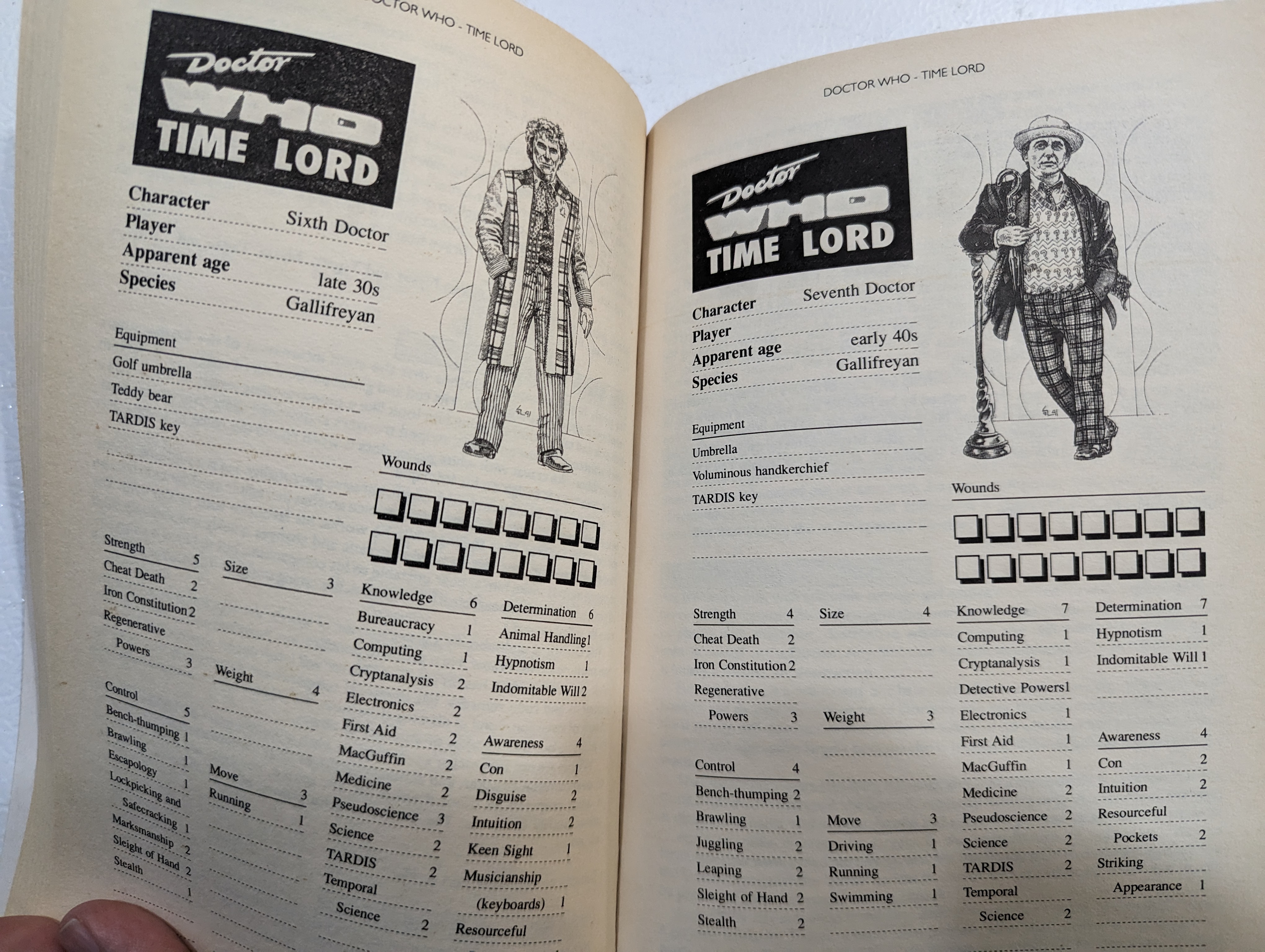
Time Lord Character Sheets

The real question now becomes, are these two traveling together? I like the idea of the Doctor being involved, particularly Sylvester McCoy's Seventh Doctor.  That is if I go with 1991, when the rules were in print. I could very easily go with 1996, the year that the game was released on the Internet, AND when the Paul McGann Doctor Who movie came out. That is also the same year that "The Craft" came out so using the logic of the TV series, the Eight Doctor is traveling with a young American witch. I don't hate the idea, certainly. 

Yeah...I don't hate this idea at all really. Maybe the bike messenger bag that Jenny has in my build above she gives to the Eighth Doctor for his Big Finish audio dramas. The Eighth Doctor's time is ripe for all sorts of shenanigans to be honest.

I'll have to consider this one more, but I like these builds and would use them to give the Time Lord rules a go. 

#Dungeon23 Tomb of the Vampire Queen, Level 5, Room 17

 Going back and this time taking the far left hallway leads to another corridor and collection of connected rooms.

Room 17

These four rooms are larger than the ones on the far right. There are plenty of flickering lights with writing that doesn't not translate. There are plenty of beds in these rooms. One has a skeleton of the snake people on it.

There are no creatures, but there are more (1d10+10) more of those "healing wands" here but only 1d6+3 still work.

--

This is the ship's sick bay. It is designed for Ophidian life, so even if anything was working it would not be good for humans.

Tuesday, May 16, 2023

Review: Time Lord the Doctor Who RPG

Time Lord
The year is 1991, and the FASA Doctor Who game is out of print. Equally less likely to see a resurgence is the Doctor Who series. In 1989 Sylvester McCoy, who had signed on as the 7th Doctor in 1987, was featured in the last "Classic" Doctor Who episode, "Survival."  The Doctor's future on BBC Television was in serious doubt.  

The Doctor had seen something of a resurgence in the Sylvester McCoy years leading to Virgin Books (founded by Richard Branson) to continue the story of the Doctor and Ace in the "New Adventures" series. The novels were very popular among Doctor Who fans, even if they took some liberties with the established lore of the show. Though some ideas (like the Time War and Other) would find new life in the 2005 reboot of the series.  But that is for another discussion.

While Virgin saw success with the novels, they found getting into the RPG market a little more difficult. They released Doctor Who Time Lord with the subtitle Create your own adventures in time and space in 1991. The book was in an A5 (148.5 x 210 mm or 5.8 x 8.3 inches) format as a novel. The authors were Ian Marsh and Peter Darvill-Evans. Both of whom had solid RPG and Doctor Who credentials.  The game has been out of print for a while, but the authors had released a copy of it online. You can still find it if you know where to look. I compared it to my print copy, and they were identical save for some updates to include the then-new Eighth Doctor. 

Time Lord

1991. 288 pages, A5. Color covers, black & white interior art and photos.

The presentation for this game is an odd one, since it came from a novel publisher rather than an RPG one. 

PART ONE: DOCTOR WHO: A Legend In Its Own Primetime

This covers the history of the Doctor Who programme from 1963 to 1989. It gives us details on the seven actors to play the Doctor. We are introduced to some concepts in Doctor Who like the TARDIS and the Companions as well. There is also a short story, The Necromancers, that is referred too later in examples. 

PART TWO: Role-Playing: What It Is And How To Do It

This covers the basics of RPGS including a history lesson complete with nods to Dungeons & Dragons. It is not a bad overview really. Designed mostly I think for Doctor Who fans that are not roleplayers already. There is a solitare adventure you can play, Switchback, with the characters Jamie and Tegan as your examples. I am just trying to imagine a situation where these two would be working together. It is more or less like a "Choose your own Adventure" sort of deal. Similar to the one found in the D&D BECMI Basic book, but you won't be carrying Tegan's lifeless body back when you are done.

PART THREE: How To Role-Play A DOCTOR WHO Adventure

This covers the basic rules of Time Lord. The system uses two six-sided dice (like the other DW RPGs) but in this one you take the difference to get your number.  So the results will be 0 to 5, with 5 (6-1) being the best role. You compare an ability to a difficulty set by the Referee. If your Ability score is lower than the difficulty score then you must roll and score higher than the difference.  So if your ability is Strength 3 (average) and the difficulty for a test of strength is a 5 then you need to roll a 2 or better. Difficulty can be adjusted as the Referee needs. There are some examples given in the book and appendix.

The Abilities include Strength, Control, Size, Weight, Move, Knowledge, Determination, and Awareness.  All (save Weight) have special abilities attached to them. The special abilities are all detailed and work like a combination of skills and advantages. 

Combat is covered, though Doctor Who is not a combat-focused game in any iteration, there is some here. It should be noted that in Time Lord, unless you are the Doctor, death is permanent. 

PART FOUR: The Cast of Thousands

This section might be where Time Lord shines above FASA's Doctor Who game. Here we have stats for all Seven of the Doctor's incarnations and all 29 of his companions, from Ace to Zoe. We also get a lot of aliens andvillains (though not sure why Sabalom Glitz is here, he is more of a comic-relief character). The Master and the Monk are two separate figures in this game.

The Seventh and Eighth Doctors

There is some coverage on various vehicles including space and time travel ones. Special attention is given over to the TARDIS as expected. 

There is even a section called "500 Year Diary" (something that just popped up in a recent Doctor Who episode I was watching too!) that briefly covers a few topics.

PART FIVE: The Never-Ending Script

This covers running a game. It also gives good examples of what the various levels of Abilities are. While humans range from 1 to 5, with 3 being average, the scale does go to 10. So for example a "comic book superhero" has Control 7 and a Time Lord like Rassilon has Knowledge 9.

There are plenty of examples of Difficulty modifiers and relative percents. So really there are some really great details here.  There are details and tips on creating your own adventures and a sample adventure The Templar Throne (or Curse of the Cyclops in the PDF) is provided.

APPENDIX 1: CREATING COMPANIONS

There are no character creation rules really in this game. The rule expects you will be playing the parts of one of the Doctors and his various companions. This Appendix though does give you guidelines on how to create your own companions. A sample companion, Alison, is given.

APPENDIX 2: SAFE COMBAT

This covers how to tone down the lethal-ness of combat.

APPENDIX 3: DESIGNER’S NOTES

Now this is pretty interesting. The designers talk about why the made the game the way they did and how to want to appeal to both sorts of fans, Doctor Who and RPG players. 

APPENDIX 4: ADVANCED CHARACTER CREATION

Now this is from the PDF version only. The print version does not have this. This addresses the original criticism that the game did not feature character generation rules. This takes the guidelines found in Appendix 1 and expands them to includes combined a point spread generation and a random number generation. This produces characters that are all roughly of the same sort of spread with some exceptional abilities thrown in. Much like the companions themselves.

Note: There are still no rules here for generating a Time Lord character. Unless that character is a Gallifreyian and a companion of the Doctor, like Susan or Romana. 

Both end with blank character sheets. The book also includes blank sheets for Aliens and Villian NPCs. 

Character Sheets

I had grabbed this PDF back in the dawn of the Internet and held on to it for years, not really knowing what I had had. It wasn't until I saw the Virgin book on sale that I finally put it all together.

The Time Lord game is very much a product of the 90s and the Virgin New Adventures here really shine through. Granted that could just be me reading into it all. I had a rather nice collection of those books, and it colored my view of the Seventh Doctor (for the better really). 

The game is not groundbreaking by any stretch, but it is much better than I originally gave it credit for and would have been great fun in the dry years following the Fox Doctor Who movie

Given the use of two d6s instead of grabbing them from your "Monopoly or Risk" games as the book suggests you can borrow some from it's sibling games that also use d6s.

Doctor Who RPGs


#Dungeon23 Tomb of the Vampire Queen, Level 5, Room 16

Taking the far hallway on the right leads to another corridor with four doors. Each door opens to similar rooms.

Room 16

Each room is dark with a large vat full of green liquid as the centerpiece.  In two of these, the vats are empty of liquid and there are skeletons at the bottom.  The glass is broken.

In room 16a there is a vat with a Saurian floating inside. If the glass is broken and the liquid drained the saurian will revive in 1d4+1 turns. The saurian (a Warrior) will be enraged and quite insane. It will attack the party right away.

In room 16c the vat has a human male. If this vat is drained the human will revive in 1d6+1 turns, scream incoherently at the party and then promptly die.

--

These are abductees of the Ophidians. They have been here for centuries kept alive and awake for all this time. The Necromancers kept these two to come back to later but never did.  The controls for the life support are damaged, so there is no way to put the victims back.