Showing posts sorted by relevance for query Ophidians. Sort by date Show all posts

Monday, May 8, 2023

Monstrous Monday: Union of the Snake

Ophidian
One area where classic Swords & Sorcery fantasy intersects with sci-fi and modern cryptid tales is that of  Snakefolk and Lizardfolk.  My desire to use these creatures as foes date back to Doctor Who's Silurians, Sea Devils, and Draconians, but also before that with the Sleestaks of Land of the Lost.  They are great foes and can be quite literally cold-blooded.  

Against threats like these, even an orc has more in common with humans.

In my games, both fantasy and sci-fi, the Snakefolk and the Lizardfolk have an alliance in their ultimate goal of killing most of the mammals except what they need for food and slave labor.  Of the two, the Snakefolk are more cunning and often (very often) more evil.

I have talked about both of these groups before, and I'll place the links below. Today I wanted to get some stats up for the Snakefolk.  

Snakefolk aka Ophidans

Snakefolk, snakemen, serpent people, or ophidians have a long-established history in fantasy, sci-fi and horror. They are a good fit for what I want to do. There are even a lot of snake cults if I wanted to tie in some witchcraft ideas.  Not to mention all the monsters associated with snakes like the gorgons, basilisk, hydra, and even the Great Serpent himself (I could go on here, but you get the point). 

Ophidians in D&D

Snake folk are such a huge feature in many of the works of the various "Appendix N" authors that one would expect to have seen more with them. Granted there are lots of adventures, especially later one, that feature the Yuan-ti.  Maybe it is because they are always featured as a species in decline. This also works for me. 

Trouble is Yuan-ti are set as Product Identity and therefore not part of the various OGL SRDs out there. But there are alternates.

Swords & Wizardry featured Ophidians in their Monstrosities book.  Pathfinder has their own Ophiduans as well. Both pull from similar sources, namely Lion's Den Press: The Iconic Bestiary -- Classics of Fantasy.   These are "updated" to 5e and are found in Frog God's Tome of Horrors for 5e. There is also the related Inphidians for Pathfinder

I do want to point out that both the Ophidian and the Yuan-ti both premiered in the AD&D 1st Ed Monster Manual II.  They don't even look that different from each other, and their descriptions are also very similar.

Ophidian

Yuan-ti

One became popular (Yuan-ti), and the other was forgotten (Ophidian) when the SRD was released. Did we merge these into one creature back then? I can't recall, but that sounds like something I would do.

Here is what I have in B/X format.

Ophidian

Ophidians are ancient people dating back to a time when humans were little more than savages living in caves. They claim descent from the time when giant reptiles roamed the land and only reptile life was to be seen. This is not entirely true since ophidians are, in truth, the descendants of an ancient group of human snake cultists. Through dark and twisted magics long forgotten, they have become more and more snake-like. The mage-priests of this cult were wiped out by the noble caste who knew of their history and now only the emissary caste remains and they are closely watched by the nobles. 

All ophidians appear as snake-like humanoids. The noble and lesser castes have human upper torsos and the lower bodies of giant snakes. The nobles have human-like heads, while the lesser have snake-like ones.  The Emissary caste (the descendants of the ancient mage-priests) look nearly human save for some snake-like features.  On the opposite ends of the spectrum are the monstrous abominations and the nearly human-looking progenitors. All ophidians are denizens of hot climates, deserts, and jungles, often found in forgotten cities or temples from when their race held greater sway in the world.  Ophidians can speak with snakes at will, as per the speak with animals spell.

All ophidians are immune to the bite of other ophidians and other snake-like creatures.   Ophidian emissaries also have a potent charm ability. Anytime they use charm magic, they confer a -1 penalty to whomever they are trying to charm. Conversely, all ophidians are subject to the same charm magic saving at -1 on any charm attempt by a foe.  This includes other ophidians (for a -2 total). 

Breeding and childbirth is tightly controlled by the nobles. All eggs produced and fertilized are kept in hatcheries controlled by the nobles and specially trained emissaries.  Criminals, human slaves, the old, and the infirm are tossed into these pits to become food for the next generation of ophidians. 

Regardless of how the ophidians see each other castes, they always view humanoid mammals, especially humans, as inferior. Squabbling noble houses will put aside all differences if they are attacked by humans or other humanoids.  For example, the Ophidian wars with the Derro are numerous and go back for a thousand years. 

Although largely humanoid in form, the ophidians still have the mentality of reptiles. Concepts such as mercy and compromise are unknown to them. They are utterly ruthless and have little concept of honor. Survival and victory are their only goals, though they can employ subtle or deceptive methods to obtain them. 

Ophidian, Lesser*

Armor Class: 4
Hit Dice: 3+1 (20)
Move: 120 (40)
  Swimming: 120 (40)
Attacks: 2 weapons or bite
Damage: By weapon (1d6) or 1d6 + poison
Special: Poison Bite
No. Appearing: 1d10 (2d100)
Morale: 8
Treasure Type: None
Alignment: Chaotic (Chaotic Evil) 
XP: 75

The Lesser Ophidian are the rank and file of Ophidian society. Lesser only reflects its status in the ophidian hierarchy and caste. They are the workers, warriors, and slaves of the Ohidian nobles. 

Lesser ophidians appear as large snakes with the muscular upper torso of a human. There are no human secondary sex characteristics among these creatures since they are reptiles. A male lesser ophidian typically has a thicker tail than a female. The males are sterile, and their only function in Ophidian society is to labor and fight. Of the females, at least 50% of these creatures are also born sterile. They are given the same roles as the males. The 50% capable of reproduction are often used as harem slaves or given tasks by the noble caste. Regardless of their caste or station, even the lowest ophidian considers themselves above all humanoids, especially humans, whom they despise. 

These ophians can attack with weapons in either or both of their human-like hands. They prefer long curved blades like scimitars and serrated or jagged edges that inflict vicious wounds. Unless directed otherwise, lesser ophidians fight to kill and then eat their prey.  They also have fangs in their snake-like heads that have a deadly poison. A bite will cause 1d6 points of damage, and the victim must save vs. poison or dies within 1d4+2 rounds. Neutralize poison magic (spell or potion) will prevent this if given right away. They are immune to the bite of other snakes and snake-like creatures.

Lesser ophidians do not collect treasure in the strictest sense, but they will keep a trophy from a fallen foe. All other spoils by ophidian law belong to the noble caste.

Ophidian, Noble***

Armor Class: 4
Hit Dice: 9+3 (68 hp)
Move: 120 (40)
  Swimming: 120 (40)
Attacks: 1 weapon or bite
Damage: By weapon (1d6) or 1d6 + poison
Special: Poison Bite
No. Appearing: 1d4 (2d20)
Morale: 10
Treasure Type: H
Alignment: Chaotic (Chaotic Evil) 
XP: 3,000

Ophidian nobles are the ruling caste of the Ophidians, and they do so with an iron fist. They appear as do the lesser ophidians, with humanoid upper bodies with the lower body of a large snake. Their heads, though are more humanoid in appearance. Though their heads are covered in fine scales, and their eyes are slitted like a snake, so they are never mistaken for humans. Similar to the lesser ophidians, only 10% of these creatures are fertile, either male or female, with the fertile ones standing above the infertile. Births among nobles then are rare.

These creatures can also fight with a weapon and prefer the same sorts as their lesser brethren. They typically only fight with one weapon when they have too, but mostly they have 2d8 bodyguards of lesser ophidians to do their fighting for them.

Like all ophidians, they are immune to the venom of other snakes and snake-like creatures. These nobles are also immune to the petrification attacks of medusae and basilisks. 

Ophidians delight in cruelty, and none more so than the nobles. The only art they create, if it can even be called that, are ways to torture and kill their enemies.

Ophidian, Emissary**

Armor Class: 6
Hit Dice: 6+2 (39 hp)
Move: 120 (40)
  Swimming: 120 (40)
Attacks: 1 weapon or spell
Damage: By weapon (1d6) or spell
Special: Spells (Illusionist magic)
No. Appearing: 1d6 (1d10)
Morale: 10
Treasure Type: O
Alignment: Chaotic (Chaotic Evil) 
XP: 950

Ophidian Emissaries are the most human-like of all the known ophidians but never say that to their faces. They appear as normal, if quite thin, humans with some snake-like features. Their tongues are slightly forked, their skin is covered in very fine scales, and their eyes are slits like a snake.  They even go as far as displaying secondary sex characteristics of humans, though they are not mammals and do not nurse or even care for their young.  Ophidian emissaries, as the name suggests, are often the means which ophidians interact with the world of mammals and humans.  They are, however, entirely subjugated by the noble class.

Ophidian emissaries can attack with weapons, but they rarely do. They all have a natural ability for illusion magic and can cast spells as a 5th-level illusionist (magic-user). Their charm ability is superior, and any Charm spell used by an emissary is at a -1 penalty for saving throws. 

Unlike their brethren the lesser ophidian class, emissaries chafe under their domination by the noble caste. However, the nobles control every aspect of their lives right down to their breeding. Nearly 90% of all emissaries are fertile, but they are only allowed to breed with nobles, never other emissaries. Emissaries discovered in unsanctioned breeding and reproduction will have their eggs or young destroyed (often eaten).  The worst offenders will even be subjected to the horrible eldritch right of Abomination, where they are transformed into a mindless ophidian abomination. 

Ophidian, Abomination**

Armor Class: 3
Hit Dice: 10+2 (65 hp)
Move: 120 (40)
Attacks: 2 slams, bite + poison
Damage: 1d6+3 x2, 1d6+3 + poison
Special: Poison Bite
No. Appearing: 1d4 (1d8)
Morale: 12
Treasure Type: None
Alignment: Chaotic (Chaotic Evil) 
XP: 2,300

The ophidian abomination is a monster in the truest sense of the word. Large muscular torso springs from a snake-like lower body that can be one, two, or more snake-like tails. some have arms ending in viscous claws, and others have long snakes for arms, complete with snake heads and mouths filled with fangs.  No two abominations are alike.  Abomination only knows anger and hate for all living things. Their fear and hatred of the noble caste is all that keeps them in check.

Amboniations attack with their claws or fists (slashing or slamming, respectively). Those with human hands can use weapons, but all prefer to attack bare-handed. Their bite is poisonous, save vs. poison or die in 1d4+1 rounds. Abominations with more than one tail, or snakes for arms can also constrict like a large python. These creatures attack without provocation and save their greatest hate for humans. Once engaged they will keep attacking until all foes are dead or they are.  For this reason, the nobles use them as front-line troops and shock troops. They are ill-suited for bodyguard work. 

Abominations come about in two distinct ways. The first, and the most common, is via birth. The offspring of a noble ophidian and a lesser ophidian has a 1 in 10 (10%) chance of being an abomination. The offspring of a noble with a noble has a 1 in 5 (20%) chance, and between a noble and an emissary a 1  in 20 (5%) chance.  The chances of an abomination being born between two emissaries are only 1 in 100 (1%).  This is one of the main reasons the nobles control the breed of their people so heavily.  The other means is via a dark ritual known to the emissaries from the mage-priests of old.  This ritual can change any type of ophidian into an abomination. They consider this to be worse than death. 

Ophidian, Progenitor***

Armor Class: 7
Hit Dice: 9 (50 hp)
Move: 90 (30)
Attacks: 1 weapon or spell
Damage: By weapon (1d6) or spell
Special: Cleric and wizard magic
No. Appearing: 1 (1)
Morale: 8
Treasure Type: Q, S
Alignment: Chaotic (Lawful Evil)
XP: 3,000

The ophidian progenitor is an extremely rare Ophidian outside the caste system.  They have no recognition within Ophidian society, but it is believed that they are the original Ophidian race and the one from which all the others come.  Unlike all the other ophidians, these creatures appear to be completely human.  The truth is, quite literally, only skin deep. They wear a skin they have created over a body covered in soft, snake-like scales.

The progenitor will rarely attack as they are far more concerned with extending their lives. It is believed that each progenitor is hundreds of years old, and some were even alive when the Ophidian nobles seized control from the mage-priests. The progenitors are all that is left of that caste.

Each Ophidian progenitor can cast spells as a 5th-level magic-user/wizard and as a 4th-level cleric.  They are even believed to know the secrets to turn a converted abomination back into their original caste.

Members of the noble caste will kill a progenitor on sight if they can or have them killed. They fear them too much. It is speculated that some emissaries know the locations of a few progenitors. But to conceal the location of a progenitor will also result in death. 

--

I'll likely have more of these guys. I have a lot of notes and other ideas.

Links

Monday, April 4, 2022

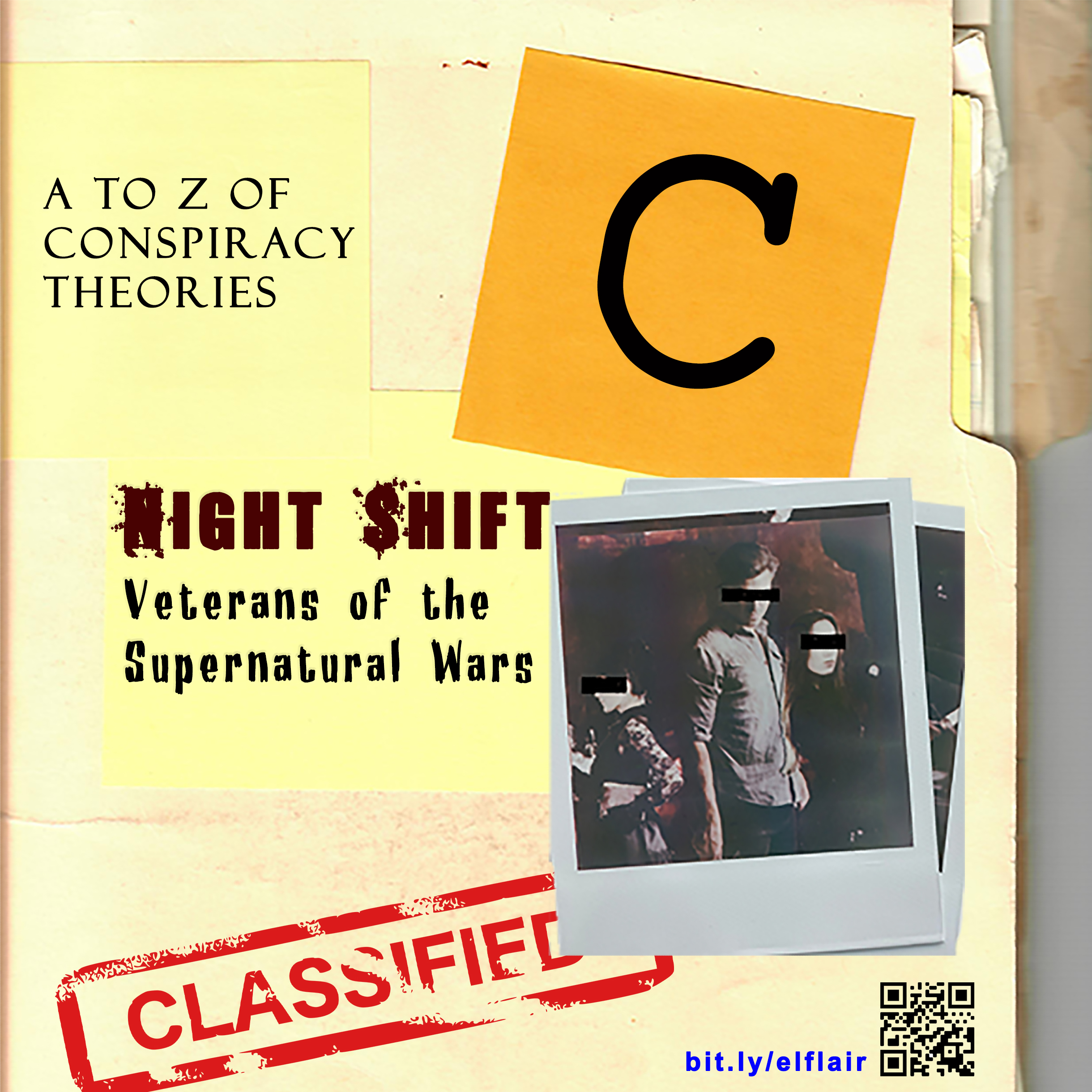
#AtoZChallenge2022: C is for Cryptoterrestrial Hypothesis

The A to Z of Conspiracy Theories C
The A to Z of Conspiracy Theories: C is for Cryptoterrestrial Hypothesis

(and a Special Monstrous Monday!)

The Cryptoterrestrial Hypothesis is the "hypothesis" (really just an idea, it's not a good hypothesis in the scientific sense) put forward by Mac Tonnies and based on, among other things, the writings of Richard Shaver.  

The idea is that all the so-called "extraterrestrials" on Earth are all really natives.  Not cryptids per se, but whole other species. They have existed, in theory since the dawn of time.

Exploring the Shaver aspect, we have the "Deros" or his "detrimental robots" as a possible Cryptoterrestrial species. If we use the D&D versions, the Derro, then we have more to work with.   I think I would also like to take another page from Shaver's book magazine and have the language the Derro use be Mantong

Another species that fits this idea for me is the Ophidians.  This is a species that I have used in the past and really enjoy them.   

What separates cryptoterrestrials from extraterrestrials are their origins. While both can seem "alien" to humans, cryptoterrestrials are Earthlings.  They evolved from the same processes that gave us trees, lobsters, and humans.  Generally speaking, the same things that affect us, will affect them. They need to eat, breathe, and even sleep. They can be affected by poisons, just different ones, and bullets still hurt them. 

For NIGHT SHIFT

Since today is also a Monstrous Monday I think I should have some monster stats here.

Derro
No. Appearing: 8-80 (8d10)
AC: 4
Move: 20 ft.
Hit Dice: 3
Special: Pack tactics, Can fight in complete darkness, vulnerable to sunlight, madness.
XP Value: 60

Derros are a race of subterranean human-like creatures.  Their skin is a dull gray, their hair is typically a few shades lighter, and their eyes are a uniform white.  They speak an unknown, guttural language, but a few (1 in 10) can speak any surface language that is common nearby.  

Common Derro Abilities

  • Pack tactics. Derro are ambush attackers and will set traps and snares to incapacitate interlopers into their realms.  The derro will kill any they suspect is a threat, usually the largest, and keep the rest as slaves. 
  • Fight in Complete Darkness/Vulnerable to Sunlight.  Derro fight in complete darkness as if it were dim light. They take no penalty in attacks.  In any light greater than torchlight/flashlight they take a penalty of -1 (-5%).  In anything brighter, the penalty is -3 (-15%).  In full sunlight they cannot attack at all.
  • Madness. A full 25% of all derro suffer from a form of racial madness.  This usually manifests as a form of delusional behavior where they feel they are the superior species of the planet.  Their layers are fill with giant machines they refer to as "The Death Ray", "The Sun Destroyer", or "The Gravity Enhancer" that are designed to end the world, but never work.  Derro spend decades building these, or more to the point forcing slaves to do it, only to have them end in their own destruction.

Derro are cruel and delight in torture for torture's sake. 


Ophidian
No. Appearing:
 4-24 (4d6)
AC: 6
Move: 30 ft.
Hit Dice: 1 to 4
Special: Cold-blooded, enhanced senses (sight, smell), poison, magicly impaired.
XP Value: Varies

Ophidians are snake-like humanoids that have existed on Earth since the time of the dinosaurs.  They remember the great age of reptiles.  They hate humans, and really all mammals, and seek to destroy them so they can reclaim the Earth as their own.  If they hate anything more than humans it is the Extraterrestrial Reptoids. They feel the reptoids caused the great blast 65 million years ago that destroyed the dinosaurs (they didn't but the ophidians are not convinced) and they fight them for control of the Earth.

Common Ophidian Abilities

  • Cold-blooded. Ophidians live in deep rain forests, inhospitable deserts, and even underground near magma pockets or anywhere that is warm.  They prefer temperatures that are 75 °F / 24 °C or warmer with places of variable temperatures.
  • Enhanced Senses. Ophidians have superior senses of sight and smell.  Their sight extends into the infrared spectrum.  They are only surprised on a roll of 1-2 on a d10. 
  • Poison. The bite of some ophidians (1 in 6) can paralyze or (2 in 6) painful death (take 4d8 points of damage).  A Constitution-based saving throw can reduce this to 2d8 hp of damage. 
  • Magicly Impaired. Whether due to their reptilian brains or the fact they evolved from different progenitors than humans ophidians are incapable of magic.  They can, and many do, have psychic powers, but never magic.

Ophidians and Derro hate each other, often encountering each other and fighting great underground battles below the feet of unknowing humans.   It is possible that the only keeping these species from taking over is their hatred for everything and everyone that is not themselves.

Union of the Snake

--

Both Derros and Ophidians have a nice long history in my games.

I have to admit they did grow out of a lot of fringe theories and weird fiction from the 80s.  But I will admit that the Snake People were really sold to me from the Duran Duran video "Union of the Snake."

It was the 80s, I took my ideas from where they came.


The NIGHT SHIFT RPG is available from the Elf Lair Games website (hardcover) and from DriveThruRPG (PDF).

Friday, September 17, 2010

The Dragon and the Phoenix: Episode 4

Episode 4: Identity Crisis

Willow: So you are saying that whole season of ‘Facts of Life’ was nothing more than unrequited lesbian love between Blair and Jo?
Tara: Absolutely, they were totally into each other, that’s why they fought so much.
Willow: Now you’re just playing with my emotions.

- Willow and Tara: The Dragon and the Phoenix, Episode 4 “Identity Crisis”


January 8, 2003 Sunday

Willow’s first big dive back into magic is to recreate Tara’s identity and remove all references of her death. A magical surge created by Yoln, the Shadowreaper, causes the magic to go awry and creates a duplicate of Tara who believes she is Kara, Tara’s twin sister. A magic ID provided by Anya also goes awry and the personality of a dead stripper is imprinted on Tara. In addition, the cast have to deal with hungry snake demons, a small gang of mobsters and a 7ft tall, one handed killing machine.
Story Arc elements: Establishes Tara’s “twin” sister Kara and Murl the demonic identity merchant. Introduces Yoln.

Notes and Comments:This is the adventure that made me forget that the show was even still on TV. Once we got to this episode things were moving great. The ideas flowed much faster. This was also our most comical episode despite the fact that it began with a dead stripper. We have "two" Taras running around, demonic identity merchants, would be gangsters, and a 7 foot tall man in armor with one arm. Plus there is the whole Tara-as-a-stripper scene.

The identity merchant was a great idea.  These are demons that make a living integrating other demons into human society.  They do it by having the demon assume the identity of someone that had died and they get all their effects, basically becoming that person.   Anya gets the id of a recently killed japanese stripper.  We also wanted to do one "Willow's magic screws up" episode and ehen never do it again.  She is supposed to be the most powerful witch on the planet afterall.  In truth her magic didn't screw up it was the combination of her magic, the dead stripper's id and the magic of Yoln.

Special note: Because of this episode Tara can still speak fluent Japanese, Amber Benson made a remark at a con a while back along the lines of "well I guess I can speak Japanese" when talking about the afterlife of fan fic. Wish I could find the link for you all.

Yoln of course is the proxy for our big bad.  We find out more about him next episode, but we learn he is the "Hand of Leviathan" whom he calls "The Whispering God".  Yoln was also an old D&D NPC that plagued my characters.

Kara, Tara's "straight" sister was an inside joke that began on the Kitten describing the soap oprea like plotting we were seeing in the show up to Season 6. We decided in the alternate past that Kara had a hugh crush on Giles. The ophidians were an old AD&D monster of mine.

The author of this adventure, Sass, has a better grasp on Willow than anyother author I have ever met. She gets her on such a fundamental level that her fiction should be required reading for anyone wanting to play Willow in a game.

Kara was not just a proxy for dead Tara, but Dawn as well. We established that she was as real to everyone, including memories, as Dawn, and a spell took her away. This was part of the alienation plot for Buffy and Dawn. Both were feeling like they were less and less human than the people around them, though for different reasons. I disliked the Slayer-as-demon (the episode where the girl was raped by a demon to make her a Slayer had not happened yet) and wanted to go a different direction, so we began by having Buffy become stronger and faster than before, becoming something other than human, or so she thought. For Dawn it was the start of her psychic powers.  I wanted both characters (via the players) to struggle with what it means to be human, or maybe no longer human.

And true to our cause here  "Candy", the dead stripper, gets avenged in the end and her killers are met with justice at the hands of the Yakuza.  Tara also gets a marker from the Yakuza boss.  The boss was named Tatsou which means "Dragon".  There is no connection, just a pun on my part to keep some element of the overall plot in every episode.

The quote above is an in-play quote between Willow and Tara.  All this terrible stuff is going around them and they are having a discussion about the lesbian sub-text of the Facts of Life.

In this episode we also established that Willow & Tara's favorite indie band is Lipkandy. They were playing the night after Tara's birthday.

At this point we began to insert a lot more crunchy stuff to our games.  Previously we had been content to use the playtest material of Buffy, but now we were moving along at good pace.  Episodes 4 and 5 were our playtests of the new Magic Box book, but we wanted to add more.

New Monster


Ophidians
Motivation: Eat humans
Critter Type: Demon
Attributes: Str 7 Dex 6 Con 6 Int 2 Per 2 Will 5
Ability Scores: Muscle 20 Combat 14 Brains 15
Life Points: 70
Drama Points: 1
Special Abilities: Armor Value 10 (scales) Qualities: Hard to Kill 3
Dodge: 14
Claw: 16 18 dam Str x 3
Bite: 15 21 dam (Str + 1) x3,
Poison
Tail slap: 15 14 dam

Ophidians are said to be a young race by demon standards, thought to exist only for the last 3 or 4 thousand years, since early Egyptian times. They are an isolationistic race, known to spend time only with their own kind, and have little regard for other demons. While most demons are decidedly carnivorous, the Ophidians are one of a few whose diet is thought to consist solely of the flesh of human beings. It is known that almost all Ophidians worship some sort of a serpent deity, but whether this is Set or Leviathan is unclear.
These Ophidians worship leviathan, but it can’t be a coincidence that many also worship Set and the cast just dealt with Set.

New Spells

Magic Missile
Quick Cast: Yes
Power Level: 2
Requirements: Witches and Warlocks need only shout “dissolvo.” Other magicians also need to meditate for one minute.
Effect: A ball of light shoots from the caster’s hand and shoves the target one foot per Success Level rolled. This spell could knock someone down or push them free from someone who was holding them. It normally does no damage, but if the target is shoved into a wall or some other hard surface, she takes double the casting roll’s Success Levels in Bash damage.
Note: This is the spell Tara used in “Bargaining”. It is assumed that Kara has it as well.

Sleep
Quick Cast: Yes
Power Level: 1
Requirements: Command word calling on the gods of sleep (Hypnos, Morpheus, or ‘the Sandman’) and a bit of sand.
Effect: Target must make a Will check. If failed the target falls into a deep sleep for one hour per level of sorcery skill.
Note: This spell is know to both Tara and Kara.

Undo Spell
Quick Cast: Yes
Power Level: 5
Requirements: Witches and Warlocks need only to command that the spell be ended. Others need to concentrate on the spell for 1 minute per power level of the original spell. If the caster does not have the sorcery levels required she can bring in other casters.
Effect: Undoes one spell or magical effect.
Since the magical effect in not natural, the magic is easy. But the witch needs to be able to overcome the level of the original spell as a resisted check.

Next Week:  Tara and Willow are targeted by assassins and they learn more of their mission here.

Monday, June 9, 2025

Monstrous Mondays: The Serpent Men of Lemuria

 Today marks the 95 anniversary of the birth of American author Lin Carter.  I didn't plan it this way, but I have been going back and rereading some of Carter's work, especially his entries in Gygax's Appendix N. So today I want to revisit a favorite bad guy of mine, the Ophidians or Snake Men/Serpent Men, and recast them as "The Serpent Men of Lemuria." 

Snake Man

I am not trying to cling to one particular idea here. This is a pastiche of many sources. Lin Carter, Robert E. Howard, Lovecraft, Clark Ashton Smith, and others. 

This recasting is not designed to be incompatible with my previous post on Ophidians, but rather an enhancement to it. 

Serpent Men of Lemuria (Ophidians)

Frequency: Rare
No. Appearing: 2–20 (nobles 1–4; lesser 2–100; emissaries 1–10; abominations 1–8)
Armor Class: Varies (see below)
Move: 12" (Swim 12")
Hit Dice: Varies (see below)
% in Lair: 60%
Treasure Type: Varies (see below)
No. of Attacks: Varies
Damage/Attack: Varies
Special Attacks: Poison, charm, constriction, magic
Special Defenses: See below
Magic Resistance: Standard
Intelligence: High to Genius
Alignment: Lawful Evil
Size: M to L (5' to 15' long)
Psionic Ability: Nil
Attack/Defense Modes: Nil 

The Serpent Men of Lemuria are the degenerate remnants of an ancient pre-human empire that once ruled the world from their black ziggurats of Lemuria. Worshippers of forgotten serpent gods, they are a deeply hierarchical species whose society is divided into castes: Nobles, Emissaries, Lessers, Abominations, and the rare Progenitors.

The Serpent Men dwell in lost cities, endless deserts, and jungle-cloaked ruins where the bones of their former empire still stand. Their society is steeped in sorcery, cruelty, and ancient blood magic.

Lesser Serpent Men (Rank & File)

Armor Class: 4
Hit Dice: 3+1
No. of Attacks: 2 (weapons) or 1 (bite)
Damage/Attack: Weapon (usually scimitars 1d8) or bite 1d6 + poison
Special Attacks: Poison (save vs poison or die in 1d4+2 rounds)
Special Defenses: Immune to snake venom
Treasure Type: Q×10 (minor trophies, jewelry)

Description: The Lesser caste are the numerous warrior-slaves of the Serpent Men, with humanoid torsos and snake-like lower bodies. They wield cruel curved blades and favor ambush tactics. Though not highly intelligent individually, they are cunning pack hunters.

Noble Serpent Men (Ruling Caste)

Armor Class: 2
Hit Dice: 9+3
No. of Attacks: 1 (weapon or bite)
Damage/Attack: Weapon (1d8) or bite 1d6 + poison
Special Attacks: Poison (save vs poison or die in 1d4+2 rounds); Command lesser castes
Special Defenses: Immune to snake venom; immune to petrification (basilisks, medusae)
Treasure Type: H, S (temple hoards)

Description: The Nobles rule through bloodline purity, cruelty, and mastery of ancient secrets. With humanoid heads covered in fine scales, they resemble blasphemous parodies of men. Their venom is deadlier than the Lesser caste, and their minds sharp with sorcerous knowledge of the old gods.

Emissary Serpent Men (Sorcerer-Priests)
Armor Class: 5
Hit Dice: 6+2
No. of Attacks: 1 weapon or spell
Damage/Attack: Weapon (usually dagger 1d4+1) or by spell
Special Attacks: Charm (victims save at −1); spells as 5th-level Illusionist
Special Defenses: Immune to snake venom; partially resistant to charm (save at +1 vs charm attempts)
Treasure Type: O, R (spell components, magical items, rare scrolls)

Description: Emissaries are the sorcerer-priests of the Ophidians, acting as the voice of the nobles to the outside world. Though appearing nearly human, they bear forked tongues, scaled skin, and slitted eyes. Their spells manipulate the minds of humans, making them ideal infiltrators and agents.

Abomination Serpent Men (Spawn of Forbidden Unions)

Armor Class: 3
Hit Dice: 10+2
No. of Attacks: 2 slams and bite
Damage/Attack: 1d6+3 / 1d6+3 (slams), bite 1d6+3 + poison
Special Attacks: Constriction (if both slam attacks hit same target); poison bite (save vs poison or die in 1d4+1 rounds)
Special Defenses: Immune to snake venom; berserk rage grants +2 to hit when wounded
Treasure Type: None

Description: The Abominations are cursed progeny — bloated masses of serpentine horror, many-limbed or many-headed, each uniquely malformed. Used as shock troops, they know only hatred for all life. The nobles use them as living engines of slaughter.

Progenitor Serpent Men (Ancient Mage-Priests)

Armor Class: 6
Hit Dice: 9
No. of Attacks: 1 weapon or spell
Damage/Attack: By weapon or spell
Special Attacks: Cast as 5th-level Magic-User and 4th-level Cleric
Special Defenses: Immune to snake venom; difficult to detect (treat as continuous nondetection spell)
Treasure Type: Q, S, U (ancient relics, rare spellbooks, forbidden lore)

Description: The Progenitors are the oldest of the Serpent Men, their bodies concealed by illusory human skins. They are few, paranoid, and driven by a desire for immortality. Most nobles seek to destroy them out of fear.

Ecology and Religion

The Serpent Men worship ancient pre-human serpent deities, long forgotten by man. Whether these are true gods or eldritch cosmic entities is unknown. In their black ziggurats, sacrifices are made to these dark powers, feeding the Ophidian sorceries that sustain their dwindling bloodlines.

The Cult of The One Who Remains

In the lost jungles and steaming lowlands of ancient Lemuria, where black ziggurats rise like broken teeth through the mists, the Ophidian Serpent Men whisper prayers to a god few mortals dare name. The humans who know of it call it The One Who Remains; the Serpent Men call it Ssath Ur-Raa, He Who Waits Beyond All Coils.

Ouroboros

To the Serpent Men, all things, kingdoms, races, even the gods themselves, are as molted skins, discarded and forgotten. After all, they watched the Old Ones rise into power and then fall into their deep cosmic slumbers. Only the great cosmic serpent at the center of all existence endures. They believe that when the final sun gutters out and the last star grows cold, The One Who Remains will still exist, coiled at the center of the void, the last and eternal devourer. It is not death, but endless, unbroken continuation. Not life, but consumption without end.

Within their ancient temples, deep beneath the crumbling ziggurats of Lemuria, the Serpent Men enact terrible rites in its honor. Victims are dragged screaming into stone chambers and placed upon altars of obsidian and jade. There, their lifeblood is spilled, seeping into channels cut into the floor, flowing in great spirals that mimic the infinite coils of their god. Blood is both offering and currency, traded for visions, power, and the brief illusion of immortality.

The priesthood of The One Who Remains is layered like the coils of their god. At its center sits the High Oracle of the Last Coil, always one of the ancient Progenitors, older than memory and rumored to have gazed directly into the eyes of the Sleeper Beneath the Last Coil. Around the Oracle gather the Lords of the Black Coil, drawn from the most ancient noble bloodlines. It is they who oversee the Abomination-Births, deliberately breeding the most monstrous of their kind as offerings and as weapons in their ceaseless wars. Beneath them are the Coilspeakers, the Emissaries who master the ancient arts of dream-sorcery and illusion. With whispered words and flickering gestures, they cloud the minds of men and bend them to the will of their Ophidian masters.

Even among the Lesser caste, faith in The One Who Remains is absolute, though their understanding is crude. They serve as the laborers, the warriors, and the butchers of the faith. For every sacrifice, for every abomination birthed, for every rival enslaved or destroyed, the Serpent Men believe themselves one coil closer to their god’s embrace.

Yet it is not merely blood and flesh they offer. The Coilspeakers enter trances where they seek visions from the outer reaches of the world, glimpsing patterns spiraling into infinite madness. Those few who return speak of collapsing worlds, of unraveling realities, and of other realms where The One Who Remains reaches through fractured dimensions to consume entire existences. Whether these are prophetic glimpses or delusions born of their own degeneracy, none can say.

To the Ophidians, all is a spiral, the twisting of bloodlines, the coiling of bodies in ritual embrace, the spiraling glyphs carved into the temple stones. And at the center of every spiral is The One Who Remains.

Even now, as the last of their ancient cities crumble, and humanity rises beyond the jungles they once ruled, the Ophidians believe that all victories of man are but passing skins. In the end, when all is uncoiled and the world breathes its final breath, only their god shall remain.

--

I have been hanging on to The One Who Remains for many years now. Trying to find good ways to sneak it into various writings. He made his first appearance in my Buffy RPG adventure "The Dark Druid" and he is the "something else" I mentioned in Fear Dorich's stats. 

Who, or what, is The One Who Remains? That is a much more complicated question and deserves a careful answer. In the future. 

Wednesday, May 3, 2023

#Dungeon23 Tomb of the Vampire Queen, Level 5, Room 3

At then of this strange cave (shuttle bay) there is indentation that looks like a door, as the party approach it, it slides open with a "whoosh!"

Room 3

This opens up into a long hallway.  Like the previous room this one is bright with flickering lights. When the party leaves the previous room and all are in the hallway the door Whooshes shut behind them.

When that happens a spectral figure appears in front of them.  The figure is humanoid but appears to have snake-like features. It speaks to the party in its own hissing language.  

Attacks against the creature fail and undead turning does not appear to affect it. The language it is speaking is unlike anything the party has heard before.

There is nothing else in this long hallway.  There are doors ahead and on the left and right. 

--

The apparition is actually a holographic message. The creature is an Ophidian, or snake man, or more to point, a snake woman, but there non of the secondary sex characteristics typically associated with mammals. 

Even if the characters can speak ophidan they will not likely understand these. This is not a spaceship but a dimensional ship. These ophidians were sent to aid the ophidians of this time and place, but they miscalculated and their ship crashed.   The Ophidians of the past fought a war with the Deros and both sides lost.  The human slaves of both groups became the Grimlocks of this island.


Monday, May 15, 2023

Monstrous Monday: Saurians and Other Reptile Humanoids

saurian
Another sci-fi staple today and one that also fits in well with Doctor Who, Star Trek, and yes D&D.  Today I want to discuss the Saurians. 

Now these guys go by a variety of names, saurians, saurials, reptoids, reptilians, and more. But for the sake of argument I am making a distinction between these guys and the Ophidians of last week. While I typically cast the ophidians as typically all evil and descended from human snake cultists, the saurians (just to use one name) are mostly neutral, cold and calculating, and largely descended from the same era that gave us dinosaurs.

I do admit that I took a lot of notes from Professor Dale A. Russell's idea of a "Dinosauriod" creature.  IT hit me at a very fertile time in my imagination; my growing love of all things science, my curiosity about UFOs and alien abduction theories, and of course, my love for D&D which was at an all-time high then. Throw in healthy amounts of Doctor Who (Silurians, Sea Devils, Draconians), Land of the Lost (Sleestaks), and Star Trek (Gorn, Saurians), and it makes a heady brew.  I also discuss them, or their near-kin, in my various posts last year on Conspiracy Theories (Ancient AliensCryptoterrestrial HypothesisExtraterrestrials on Earth).

D&D already had Lizard Men and, to a degree, other reptilians. They would later move Kobolds over to be more reptile-like (something I have worked around) and introduce more reptilian races that are even closer to this idea (Saurian, Saurial).  We also get one of the "Big Bads" of the BECMI D&D line, the Carnifex, who works with this idea.

I used these guys for years but mostly just used Lizard Man stats. Over time I adapted them and changed them to what I mostly use today.

Saurian

Saurians are a reptilian race that came about around the time dinosaurs walked the world. They appear to be humanoid, but this is a case of convergent evolution; they have no biological relationship to the other humanoid species found in the world. 

Saurians are divided into castes based on their roles in society. These castes are purely functional in nature, and while each caste feels they contribute more to their society than the others, all are required to make their society function.

  • Workers - These are the vast bulk of the Saurian society. They perform the labor and all the tasks needed. They average 5' to 5½' in height and weigh 80lbs to 100lbs.
  • Warrior - These Saurians are dedicated to battle and defending the Saurian tribes. They are prone to battle frenzy and blood lust. They average 7' to 8' in height and 250lbs to 325lbs.
  • Noble - The ruling class of Saurians. Stand around 6' high and weigh 150lbs.
  • Scientist - nearly indistinguishable from the Noble caste. Noted for the high intelligence.
  • Psionicists - on the surface, they look like a Worker or Noble but are characterized by advanced psionic powers.

All saurians are reptilian with large forward-facing eyes. They have three fingers and a thumb on each hand. They also have broad, three-toed feet. Their skin tones can vary from green to pale to even near-pink. There is no color combination between castes; any color saurian can be born to any caste. 

Females are slightly larger than males. There are no mammalian sexual characteristics, Saurians do not nurse their young, and males do tend to be more brightly colored. In the vision range of the Saurian eye these color differences are far more pronounced. Creatures with infravision can see these differences.

While many perceive the Saurians as evil, they are, in truth just very amoral when it comes to other life. They see all mammals as potential enemies and/or food.

Saurians are ancient enemies of the Ophidians and the Dragonborn. 

Saurian Minds

Saurian reptilian brains work differently from that of mammals. This has a few effects when in regards to other creatures. 

This makes giving them an alignment trickier. Slaughtering a group of humanoids, including the very young and very old, would be seen as an evil act by most creatures, but for the Saurians, it would be a necessary part of remaining alive and providing for their own tribe; an act they would view as good, even lawful.  Many humanoids would chafe under their rigid caste system, but to a Saurian, it ensures that individuals are living up to their greatest potential. No Saurian would want a Scientist as a Warrior or a Noble as a Worker since they would all be very ill-suited for the jobs. 

The other effect is one of magic.  All saurians, regardless of caste, have a +2 bonus to saving throws on all mind-affecting magics. This includes Charm, Hold, Illusions, and Sleep spells. It also means they have a +1 on all saves on other magic except for those that deal direct damage. Even a healing spell cast on a Saurian must first be subject to a saving throw. If they make the save they are not healed.

Consequently, Saurians are not able to take levels in any magic using classes like Cleric, Magic-user, or Witch.

Saurian (Worker, Scientist, Noble)

Armor Class: 7
Hit Dice: 2+2 (11 hp), 3+3 (17 hp), 4+4 (22 hp)
Move: 120 (40)
Attacks: 1 by weapon
Damage: 1d6
No. Appearing: 2d10, 1d8, 1d6
Morale: 8, 10, 10
Treasure Type: None
Alignment: Neutral (True Neutral/Unaligned) 

Saurians are a reptilian race of humanoids. They are born into a rigid caste system based on their biology. Each caste feels they contribute the most to their society, so inter-caste conflict is much rarer than intra-caste conflict. 

The Worker, Scientist, and Noble castes are largely indistinguishable from each other to outsiders. The worker caste is the most numerous, and the nobles are a little taller. 

Workers: These laborers handle all the labor in a Saurian tribe. This includes everyone from the ones that build homes to healers to those that care for eggs and hatchlings.

Scientists: Generalized by their higher intelligence and pursuit of ways to improve the Saurian people.

Nobles: The ruling caste of Saurians.

Since all saurian eggs are kept in hatcheries, there are no parent-child bonds but hatchmate bonds. So in this manner, a worker can claim kinship to a noble and visa-versa. These bonds are just as strong as any mammalian parent or sibling bond.

Saurian, Warrior

Armor Class: 7
Hit Dice: 8+2 (56 hp)
Move: 120 (40)
Attacks: 2 by weapon
Damage: 1d8+3 x2
No. Appearing: 1d8 (3d6)
Morale: 12
Treasure Type: None
Alignment: Neutral (True Neutral/Unaligned) 

Saurian warriors are a caste unto themselves. The largest and healthiest hatchlings are trained from birth to be warriors whose only purpose in life is to defend the Saurian tribes. Warriors will fight among themselves to establish dominance and access to resources, but they will never attack anyone of the other castes. They find such ideas repugnant.  

However, a Saurian warrior will have no qualms attacking a group of humanoids; young or old, as they only see mammals as potential food. 

Hatchmate bonding is the strongest among the Warrior caste, with warrior Saurians dedicating their lives to protect their hatchmates.

Saurian, Psionist

Armor Class: 7
Hit Dice: 4 (18 hp)
Move: 120 (40)
Attacks: 1 by psychic attack
Damage: see below
Special: Psychic powers
No. Appearing: 1 (1d4)
Morale: 12
Treasure Type: None
Alignment: Neutral (True Neutral/Unaligned) 

Psionic Saurians are the rarest and sit somewhat outside the Saurian caste system. They look like Noble or Scientist Saurians, if somewhat smaller. They are identified early, taken from their hatcheries, and raised only with other Psionic Saurians. Thus they have the weakest hatchmate bonds of all Saurians, and intra-caste violence between psionics is the highest of all castes. 

Saurian Psionists have the following powers. These are not magic powers but instead are psychic in nature.  

There are stronger psionists with more powers.

Note: The powers are not magical and cannot be detected or countered by magical means.

Monday, March 4, 2019

Monstrous Monday: Snakes. Why did it have to be Snakes?

A little something different today for MM.  I want to talk about snake people.


Snake people, serpent folk, Ophidians, Yuan-ti whatever you want to call them they have been a staple of fiction and D&D since ... well likely forever.

They were common enough in the pages in the Conan that even as a casual reader of the pulps I had heard about them.  They have had a prominent focus in AD&D with the Yuan-ti; so much so that there are one of the very, very few monsters that are IP and Closed to the OGL.
So yeah, they come with some history.

I think it is also that snakes seem so loathsome to humans.  There is just something "evil" about them in our collective subconscious.   That makes them a great old-school threat.

Review: Serpentine - Oldskull Serpent Folk

Serpentine - Oldskull Serpent Folk from Oldskull, aka Kent David Kelly is a nice RPG for adding and using Serpent Folk, known as Serpentine here, in any old-school like game. The book is 41 pages with cover and OGL statement. Everything is 100% open minus the usual trade dress and some names.  The book is full color, but mostly public domain black and white art.
The purpose of this book is to bring together various mythos and stories together to present a cohesive whole narrative of a primordial race of serpent people.  In this respect, it works rather well.
History and Pre-History of the Serpent Folk. Drawing on the works of Dunsany, Lovecraft, Howard, and Smith Kelley weaves a history (or Hisssstory!) that combines the Hyborian Mythos and the Cthulhu Mythos, with other myths of the world added for good measure.  While overtly for the Oldskull world it can be added and modified as any game master needs.  One of the reasons it works so well here is that Kelley draws on some primordial myths and legends.  The same that influenced the authors of the stories being used.   Quotes from those authors are found throughout this book.
Up next we get a Serpent Folk Truename Generator.  A useful tool to help you name all those NPCs (or even PCs) you plan on using.  This is followed by Description or what your serpent folk looks like.  A section on Ability Minimums, Maximums and Modifiers is next. After that are sections on Behavior, XP modifiers, and views on Alignment.
There is a list of serpent folk deities from other myths.  It is a good list, but I have a few issues with some of the gods on it; for example Brigid. But the vast majority I see why they are there.  Mostly Serpent Folk are going to worship Yig and/or Tsathogga, though Set is a close runner up.
We get into a section now on Class Options for Serpent Folk. Most are going to fall into the various fighter classes and thief-related classes.  Also presented here is the new Soul Slaver class, which combines Cleric, Shaman, and Necromancer all in one serpent-related class.  It's a good class and it adds a lot of flavor to the Serpent Folk.  I might tweak it to be less Necromancer and more Shaman myself, but that is only personal bias, not a shortcoming of the class.  Basically, the class draws on the souls of the deceased to perform magical feats. There are spell lists, mostly from the classical B/X and Advanced sources.    They advance as Magic-Users, but have their own spell progression and, in a nice old-school touch, level titles.
There is also a section on Racial Powers serpent folk get and what kinds of snakes they are likely to summon.  This also included specail attacks and special limitations.
There is a nice section on how Serpent folk get along with Dragons (spoiler, they don't) that really sealed the deal for me.  I have been using various serpent-like races (Yuan-ti, Naga) as the ancient ancestral enemies of the Dragonfolk (Dragonborn) for years.
We end with a recomended reading list.
So for just $3 and a little over 40 pages this book packs a lot in.  There are so many cool ideas it is hard to figure out where I want to start with it.  I think that since Kelley tapped into some primal myths here that all gamers have an idea of these creatures, he just put it down in writing for us.

PWWO: Serpentine in Other Old-School Games

Astonishing Swordsmen & Sorcerers of Hyperborea has been my obsession over the last few weeks. Given the background of both AS&SH and Serpentine, it should really be no surprise then that I see the two of them working quite well together.  With the addition of Serpentine you can really "punch up" the stats for Sanke People in AS&SH. Already an interesting monster, now with this addition Snake People go from "just another monster" in the Bestiary section to potential Big Bad material.  Growing cult activity? Serpent People. More dinosaur sightings? Serpent People.  Increased slave trade? Yup. Serpent People.   Plus AS&SH and Oldskull Serpentine draw from exactly the same sources. They just rearrange things in a different order.  Both books feature Yig and owners of one book should find it to be of positive use when used with the other book.

Serpentine features the often used Clark Ashton Smith god, Tsathoggua.  Here he is considered to be a god of the Serpent People. AS&SH has the god Xathoqqua, which is the same god.  There are some differences in how they are portrayed in each book, but gods are supposed to be mutable.  Of course, the best source for Tsathogga (yet another spelling) is from the Frog Gods themselves in their Tome of Horror Complete.  Here he is presented as a demon, but that is perfect for me really. The same book (and the Tome of Horrors 4) have the Inphidians, which are their versions of the Yuan-ti, save Open for the OGL. Speaking of the Frog Gods, in their Monstrosities book feature Ophidians, a name I have also used in the past, as snake men.

The OSR games Blueholme and Adventurer Conqueror King System both have rules within their systems to allow Serpentine player characters. All you need really is the Serpentine book.


Union of the Snake: The Second Campaign

The heroes of the Second Campaign, my D&D 5e nod to old-school gaming, have already had their first encounter with the Yuan-ti.  They have encountered other snake-like creatures and reptiles worshiping snake gods, but everything is about to go into overdrive when they hit their desert-related adventures.

While the campaign is 5e based there is a lot of old-school influences in it.  I plan to take a bunch of the material above, put it in a blender then bury it in a desert for 3,000 years and see what comes up.
For me a lot of it is leading up to the ultimate confrontation with Demogorgon.
Borrowing from Advanced Labyrinth Lord I am using Demogorgon as the cult leader behind the snakes and snake men.  This fits in with my use of the blood apes as one of the three factions the worship Demogorgon; with human cultists and Ophidians/Snake Men/Serpent Folk being the other two.  The campaign will take a solid desert/Egyptian turn here soon.  I just need to figure out the Set-Apep-Yig-Demogorgon connection.

Of course, there will be creepy ass snake-men and cultists. All part of the alchemy of my past. Yes. My influeces for this are an forgotten Dirk Benedict horror movie and Duran Duran.  My game, my weird ass childhood.

Monday, January 13, 2014

Come Endless Darkness

No. Not the Gary Gygax book, but related.

I have been thinking a lot about the 1st Ed AD&D game my kids are in now.   They love play 1st ed more than 3e I feel, but what is missing from this game, at least how I initially conceived it, is an epic arc.

In this campaign the characters are going to get involved in something huge, something world changing.  Since these characters are the sons and daughters of their 3e characters I also want some thing that alters the feel of the game world to help explain the shift in rules from 3e to 1st Ed.

So I am going back to an idea I had years ago that I originally wanted to try for 3e.  It was going to be called Shadow Earth and bits and pieces live on in my other products and posts.
I am planning to blot out the sun.
This was something that I toyed with now and again and thought it might make for a good plot. It was also one of the ideas I threw out later on as an idea for my "no big bad" game Season of the Witch.

The idea is a simple one really.  The vampires, drow and mind flayers* (or maybe the mi-go have not decided yet) join forces to blot out the sun.

The PCs discover part of this plot after they bust up a slaving operation being run by vampires (A series).  Unlike like other games though, the bad guys succeed in their plans and the sun goes dark.  While the big powers of the world are meeting to discover how to reverse it (and thus not able to help out their offspring) the new generation is sent off to investigate reports of giants attacking a village nearby (GDQ).

So yes I am using modules with this.  I figure I have come up with say about 100 unique adventures over the last 35 years or so.  These allow me to ease some of the heavy lifting AND also to give my kids a shared experience with other gamers.
Here is the plan so far.
  • B1 In Search of the Unknown, levels 1-3 (played at Gen Con 2012)
  • B2 Keep on the Borderlands, levels 1-3 (playing now, will include a shrine to an evil god of chaos)
  • T1 Village of Hommlet, Intro-levels (might not use now, depends on how the Temple of EE fits in)
  • L1 The Secret of Bone Hill, levels 2-4 (maybe)
  • X2 Castle Amber, levels 3-6 (the MiGo plot)
  • A0 to A4, levels 4-7 (the vampires get their victims from the Slavers)
  • A5, The Last Slave Lord, levels 5-9 
  • I1 Dwellers of the Forbidden City, levels 4-7  (snakemen - minions)
  • C1 The Hidden Shrine of Tamoachan, levels 5-7
  • G123, levels 8-12 (drow)
  • D12, levels 9-14
  • D3, levels 10-14
  • Q1, levels 10-14
They are currently going through Tomb of Horrors under 3e, and I am thinking of running Expedition to the Barrier Peaks under AS&SH.

The idea then will be that the PCs discover the plot and have to destroy the device blocking out the sun on Lolth's plane.  IF things work out and we have more time or they want to go on then I *might* work in the old H4 Module, Throne of Bloodstone and redo it a bit to give them a second part to destroy.

Things I have not yet figured out.  I would love to use my Ophidians in there somewhere.  I should really since they a cool race and work well.  I will have to use my take on Demogorgon then as well.

Mindflayers seem like a no brainer to me which means I should really investigate why I am using them.  I think they should be part of a more Mythos-like mindset.  Their goal of course is to enslave the entire world.  But do they have a demon lord they answer to? Not likely.  Given this many factions I need to figure out their motivations.  Why? Well that will tell me how the players will be able to succeed.
Maybe the Ophidians are in league with or controlled by the mind flayers.

I want to give them an epic. I want this to feel like opera; like all three parts of Wagner's Ring Cycle.
At the end I want to be able to look over the table at their faces and know they know what it is to shake the pillars of Heaven.  I felt that when the I was done playing in the "Dragon Wars" in 1988 and again when I ran "The Dragon and the Phoenix" in 2002-2004.

Regardless how epic it might be, it will be fun.

Monday, June 15, 2009

Desert Elves & Orcs

I was working on a desert based adventure for my son's game the other day and I got to thinking about some things I really liked from AD&D 2nd Ed. Desert Elves and Al-Qadim. In my Mstaroerth world I have an area that is roughly equal to the Sahara desert. I am thinking of putting some the Al-Qadim stuff there. I would include Desert Elves, that also appeared in 3rd Ed. For me the desert elves would be tall, thin, dark skinned and be the merchants and royalty of the land. I would use them to typify what is thought of as the best stereotypes of Muslims and Arabs (the hospitality, the reverence for tradition and religion), not that there would not be "Bad" ones per se, but I am saving my bad guy role for another race. Humans. Humans of this land fell prey to the Necromancer Kings and thus most humans are seen as defilers, infidels and outright evil. Most of the time this stereotype will play out.

But what about Orcs? Well if the desert elves are the sultans and emirs of the land, then the orcs are their body guards. That's right. I want elves and orcs working together. What happened was many millennia ago when the Necromancer Kings rose to power it was the elves and the orcs that fought them. Once united they then discovered that they had skills that were mutually beneficial to each other. Orcs are still militaristic with small war cadres connected to powerful elf families. For an orc it is an honor to serve since the more powerful the elf family the stronger their own cadre is respected. The stronger the orc cadre, the more respected the family is and the more likely they will get goods to trade. An elf sultan will travel without his wife for example, but never without his orc escorts. I am also thinking that these groups of elves and orcs have also never heard of the elf-orcs wars that plague their cousins. Again stealing a bit from Al-Qadim here, but that is cool. Unlike Al-Qadim I was thinking of making these elves monotheistic and the orcs still worshiping altered versions of their own gods. For example Grumush was a great military leader, not a blood thirsty killer.

There were no Halflings, gnomes or dwarves here. But I will use Yuan-Ti, or rather my world's counter-part, the Ophidians. I have not decided on classes yet, but I am sure they will be slight alterations on the existing ones. For example a Sha'ir will be a normal magic user in OD&D or Spellcraft & Swordplay, and maybe a special kind of warlock in 4e. I have not figured out all the lands yet other than basics, but I am getting the urge to pull down my Al-Qadim information. I'd add some Dark Sun into it as well, IF I felt it fit and it really doesn't. Dark Sun always felt more "John Carter of Mars" to me than "Arabian Nights". What I like most about this idea is it is not Tolkienesque-fantasty-Europe.


I mentioned my Ærypt is a pastiche of Arypt, Erypt and Egypt with Gygax's Necropolis and Ravenloft's Har'Akir thrown in. So this is the lands west of that.

Looking forward to seeing where this takes me.

Tuesday, May 9, 2023

#Dungeon23 Tomb of the Vampire Queen, Level 5, Room 9

 Across from Room #8 is another wide-open room. This one has a large window that allows a view of the hall to the entry.

There are also several metal and glass-looking shelves, some with blinking lights. There is someone sitting in one of the chairs.

Room 9

If these "shelves" (control panels) are touched, some will light up and noises can be heard. In one case an alien voice (a recording) can be heard. 

The someone sitting in the chair is long dead. The skeleton looks like a cross between a human and a snake. It is wearing one of the suits found in previous rooms.

The badge the skeleton has on its uniform appears to be gold.

[NOTE: if any character is a Dragonborn or the equivalent, then they are very, very uneasy around this skeleton but can't tell you why.]

--

The someone is a dead Ophidian officer. 

The voice is a recorded message from a shuttle crew trying to leave the ship before the crash. They, along with their shuttle, are buried a few hundred miles west of here and 300 ft. down.

Dragonborn and Ophidians are ancient enemies. Their hatred is buried deep in their collective unconsciousnesses. 

Saturday, April 9, 2022

#AtoZChallenge2022: H is for Hollow Earth

The A to Z of Conspiracy Theories: H is for Hollow Earth

Actually of all the conspiracy theories I have presented here, the Hollow Earth is one of my favorites.

It is just so crazy and so much fun.

In truth, many of these ideas come from my father-in-law who had a rather impressive collection of books and underground films about this stuff.  I like to pretend he didn't believe them all and like me, he just got a lot of enjoyment out of them.  Well, this is true, but ask me again when we get to Tesla.

So the Hollow Earth.

This one is a topic I have talked about a bit here in the past.  

From the fantastic Ubiquity powered game from Exile Game Studio,

To the Hollow World of Msytara,

Tales of Journey to the Center of the Earth and Pellucidar filled my childhood.  So as far as conspiracy theories go, this one was a welcomed one, but one that never left the realms of fiction for me.

Great tales when you are a kid, bad science when you are older.  

It was not until my father-in-law introduced me to this strange book he got about the Hollow Earth by Raymond Bernard.

Hollow Earth

Hollow Earth

Hollow Earth

It ties then UFO literature and research to the Hollow Earth.  A lot of it is crazy pseudo-scientific nonsense, premises stretched thin and beyond credulity, and shoddy correlations that are not even remotely connected.   So it is easy to see why people who are not trained in science are taken in.

Yet, unlike the Flat Earthers (who are as you recall morons) the Hollow Earthers seem almost quaint in a naïve, harmless old uncle in his dotage.  "Of course, the Earth is Hollow, now let's get you back to bed." 

For NIGHT SHIFT

On Monday I mentioned two "alien" species that came from under the Earth.  Could their origin be the Hollow Earth?  It certainly sounds fun to think about, but I think I much prefer an "underdark" sort of Hollow Earth with large pockets of emptiness where these communities of Derro and Ophidians can live and where they do battle with the Reptilians in their underground bases. 

Maybe not full-on Agartha or Pellucidar, but more akin to Jules Verne.  There are Pulp roots to NIGHT SHIFT if one cares to look.  The Hollow Earth also had pulp roots.  It is therefore not inconceivable that a group of adventurers from NIGHT SHIFT could find themselves on their own Journey to the Center of the Earth.

Hollow Earths


The NIGHT SHIFT RPG is available from the Elf Lair Games website (hardcover) and from DriveThruRPG (PDF).

Friday, May 26, 2023

#Dungeon23 Tomb of the Vampire Queen, Level 5, Room 26

 The hallway/corridor opens to a larger corridor.  A large room can be seen at that very end. 

Room 26

The necromantic forces feel stronger here, like they did on previous levels.

As the characters move down the hall, they are attacked by Zombie Ophidians.

There are 1d8+4 zombies of the snake men. They have no weapons and attack with claws and bites. Their poison bite is all used up so they only do 1d4 hp damage per bite.

Friday, July 18, 2025

Fantasy Fridays: Atlantis The Second Age

Atlantis: The Second Age Khepera Publishing Edition
 Today's game is not something I am proposing as a D&D replacement, which is interesting given the game and the history of the games that led up to it. I was thinking about it after going through the Barbarians of Lemuria RPG a bit ago. These two games, though, are a good addition to your current Fantasy games. And maybe, for the right table, it is the game they need.

Atlantis: The Second Age

Morrigan Press Edition, 2005, 411 pages
Khepera Publishing Edition, 2014, 368 pages

Atlantis: The Second Age, both versions, is the spiritual successor of the classic Atlantean Trilogy and Talislanta by Bard Games, which, of course, were developed after the Complete Adventurer, Spellcaster, and Alchemist books.  Those books were written to be used with "any fantasy role-playing game," but the obvious choice was AD&D 1st Edition. 

The book is titled “Atlantis, the Second Age,” so it is Atlantis, after the Flood. A bit odd, but I’ll go with it. Plenty of information on the world, and despite the name, you could run it as a pre-flood/pre-sinking Atlantean empire. Tons of new races, spells, and magic, all pulled from the old Bard Games books and a variant of Talislanta’s rules. If you've played Talislanta before, you'll feel right at home especially since this is a spiritual descendant. 

The game uses the Omni System for the 2005 edition and the Omega System for the 2014 edition. I'll get to the Omni System after a bit, but both are very similar to each other. The systems are similar to True20, and can be used in conjunction with True20 with some adjustments. Well. Some radical adjustments, but it can be done. For a bit in 2005 I tried a short Atlantis based game using True20, it worked out well. 

The 2005 edition was originally published by Morrigan Press and is the one I was most familiar with. Though here on out I'll focus mostly on the 2005 Morrigan Press version, with bits from the Khepera Edition as they come up. Khepera Publishing, which is Jerry D. Grayson, published the revised and updated edition in 2014. Both editions are now published by Khepera Publishing. 

Atlantis

Let’s start with the world, because that’s the real star here. This is mythic prehistory, a time before the oceans swallowed everything, when man fought serpent-men and sorcerers whispered to gods that had no names.  These are set in the Atlantean Age world, which is similar to the Hyborian Age, but maybe a bit before it. It has a solid Conan-esque feel to it. Except there are a lot of non-human species here. 

Think Conan, but written by Clark Ashton Smith and Michael Moorcock and published in Heavy Metal.

What I like about this game is the Greco-Egyptian feel to this world. Obviously, this is due to the stories and tales of Atlantis. It also feels like a world out of mythology. If you never play this game, the background is something I keep coming back to time and again. I recall reading the Morrigan Press edition while holding my oldest son when he was a baby.  The Khepera edition is an improvement over the Morrigan Press edition, but both are great. There are enough differences between the games to warrant discussing them as different games, but enough similarities that I am keeping them together. The setting remains the same, and the basics of the rules are sufficiently similar.

Atlantis The Second Age by Morrigan Press, 2005
Background

The game begins with a background familiar to many who have played D&D or read any of the Appendix N books. It is a Mythic Age before recorded history in a world that looks like ours. As I mentioned above it has a solid Conan/Pulp feel to it. Ophidians are the bad guys at the start of this and can be an ongoing threat. I also can't help but get a little Edgar Rice Burroughs / Mars feel from this. Lots of different species/races all living on the same planet. It feels like a Conan game, only with more Greco-Egyptian elements.

The 2005 Morrigan Press version has more background on the geography of the world, a little more than half the book to be honest. For this reason, it makes it a good buy if you want to play in this Atlantean world. The 2014 Khepera version has more historical background and a good timeline of events. 

The games are set up in similar fashions. Choose your background, race/species, and then select either a profession with some skills (Morrigan) or a set of skills with a profession (Khepera). Both get you the same places in the end. If you are familiar with the old Arcanum books, then you know what sorts of "classes" and species you have choices of.  While there are professions/classes of sorts, it is skills that really define what your character can do. 

The species, in particular the Andaman, are particularly fun. The Ahl-At-Rab make for a very playable Lizard Man species and this might even be the origins of my Saurian-Ophidian war in my current games. Feels right even if I can't fully recall it.  An aside: This is one of the main reasons I enjoy revisiting these older games; it's the memories they stir up in me. 

Of note. The 2005 Morrigan Press edition does have Elves and Dwarves. The 2014 Khepera Publishing one drops them in favor of focusing more on the unique species of the lines and adding the "First Born" the Djinn. All of these can be ported over to your favorite D&D-like with little effort. 

The Khepera Publishing version has their "Walk Life Paths," which help define who your character is since you are already starting out as a hero among normal humans. It is quite interesting to be honest, and easily adaptable to pretty much any game. 

Magic

While there are magical professions, there are also magical traditions. Witchcraft is one, as are shamans and practitioners of the Dark Arts. Both games have you build your spells based on the different Modes of spellcraft, and some traditions are better and worse at some modes than others. It this sounds a little like Mage and their spheres then you have the right idea, though it is not as complicated as that. 

It can be a dynamic system, and there are some example spells to get you going.

Omni & Omega Systems

The system for each is similar. Close enough that broad strokes will suffice. Both are d20-based systems. Roll a d20 add modifiers from abilities and skills, look for a target number. I mentioned they are both very similar to True20 in this respect since all you need really is a single d20. 

The Omega system has characters that are slightly more powerful than a standard normal person. So more powerful than say a 1st level AD&D character, but maybe not as powerful as a 1st level D&D 5e character. The Omega system also features a lifepath system that helps to flesh out a character's background, providing them with a history and motivations from the outset. This also informs how your character moves forward, or maybe a better phrasing is how they could possibly move forward since the options are still up to the player.

Both systems, though, are easy to pick up. Morrigan Press still sells the Omni System as a separate generic system. 

Larina Nix for Atlantis: The Second Age

A dedicated witch tradition and a funky magic system? You know I am going to try that out. Though stating up Larina for an Atlantean game is really not a stretch. Back in college, in the last days of AD&D 1st ed, I ran an off-and-on "Atlantean" campaign. I would later supplement the lore with bits from the Talislanta RPG that was released later (90s). It was largely divorced from my high school game, except at two points. First, my necromancer "Big Bad" Magnus was there before he turned completely evil.  It was in a sense his big origin story. Additionally, the "very first" incarnation of Larina was also there. While her first version was my AD&D 1st ed version, I was coming up with the idea that she was reincarnated many times, and her first incarnation was a priestess or witch who died when Atlantis sank below the waves. I do not recall if I ever had Magnus and Larina meet in Atlantis. Nor even if I ever had planned them to meet. Magnus was always more an enemy of the Werpers and the occasional ally of my assassin. Magnus and Larina knew of each other in AD&D and beyond, but she avoided him. 

So yeah, I really just took a lot of late 70s Atlantic Lore about psychic powers, energy crystals, an episode of In Search Of, a cheesy documentary I had watched in the early 80s, and the Doctor Who episode The Time Monster. A heady brew to be sure.  The point is, if there was questionable scholarship about any sort of occult topic, I was going to try and add it to my games and somehow, somewhere, one of my witches was going to be there. 

Larina in Atlantis

Working through the character creation was a lot of fun and really shows where the  2014 Khepera edition grew. It also highlighted the similarities and the differences of the two systems. To be fair the differences are subtle and you could play either system and switch to the other with only a few problems. The differences are akin to Basic D&D and Advanced D&D 1st ed. My opinion that both games would work well together still stands. Each has something to offer the other. 

I don't remember everything about Atlantean Larina. I knew she was not an Atlantean native. I was using my own experience of going away to college to say she had also left her home to study magic at Atlantis. So I kept that bit and said she comes from Alba (England/Scotland). As I was generating her stats I opted to have her at age 25 for the 2014 Khepera edition and 35 for the 2005 Morrigan Press edition. I used 35 because that is how old I was when I originally created her stats for the Morrigan Press edition. I do remember she was in Atlantis when it finally sank beneath the sea, and she died with everyone else. Hey, death is a part of the life-death-rebirth cycle, and no one knows that better in my worlds than witches. 

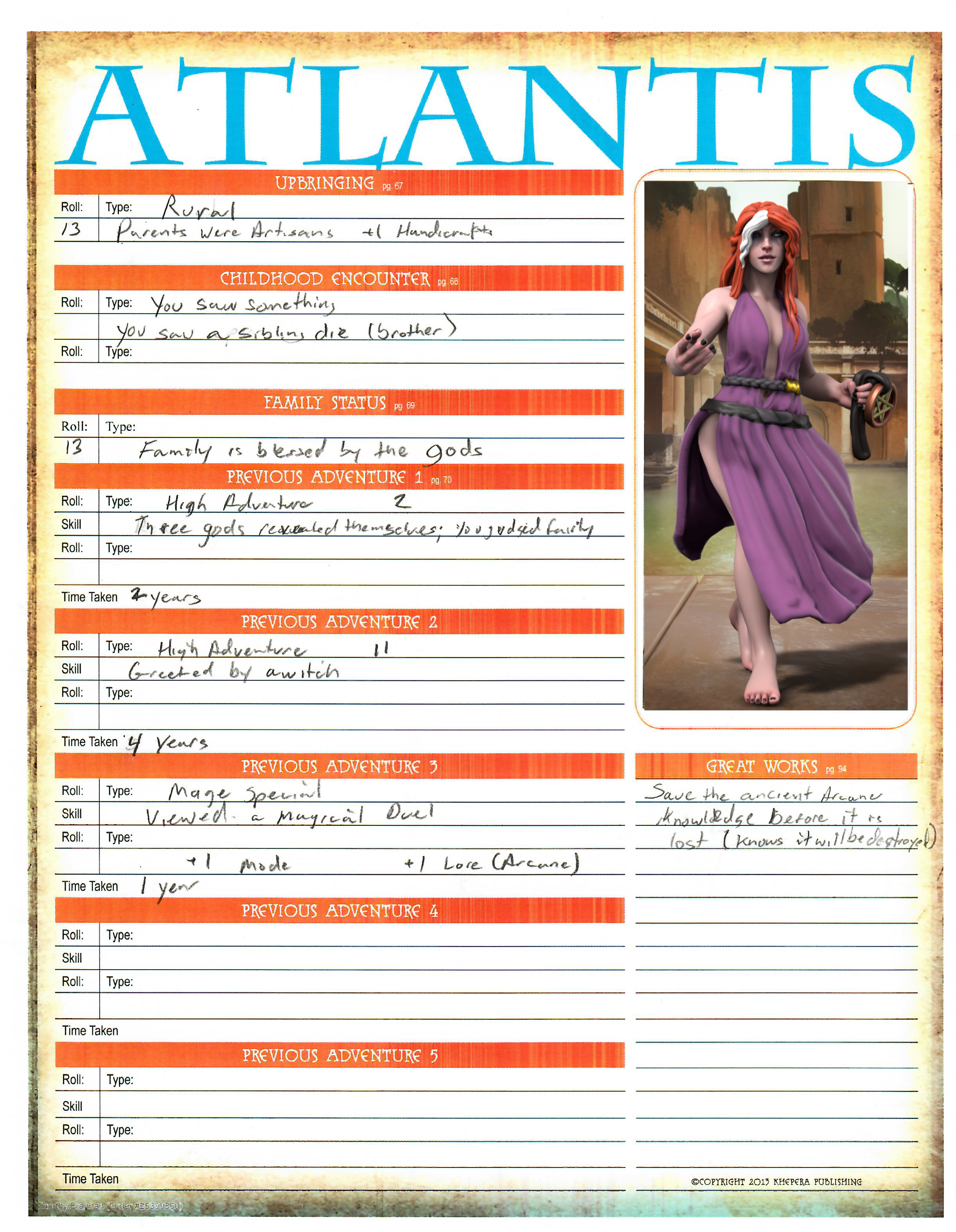
I am taking scans of her sheets to show what they look like. I particularly like the 2014 Khepera version. It is colorful and there are page numbers on the sheet to help find where the rules for that section are. That is a rather nice touch. Click to see larger.

Khepera Publishing (2014), Larina age 25

Larina - Atlantis the Second Age (2014) Larina - Atlantis the Second Age (2014) Larina - Atlantis the Second Age (2014)

Morrigan Press (2005), Larina age 35

Larina - Atlantis the Second Age (2005) Larina - Atlantis the Second Age (2005)

I am rather happy with these. I have filled out everything, but you certainly can get the idea. She would be a good witch in this game. I am going to say in the 10 years she has been in Atlantis, she has picked up more skills and the Astrology and High Sorcery traditions of magic work. This is a subtle nod to the crazy 70s and 80s "documentaries" I watch on Atlantis, the Bermuda Triangle, and related topics. 

Given the image I created (thank you, Hero Forge!) I think that the Orichalcum pentagram she is carrying must be important. Maybe a quest for a different incarnation of Larina.

Who Should Play This Game?

There is not much here that can't be found in other games, really. Nearly every Conan game does something similar, and Wasted Lands does the best job of all. BUT that is not a reason for you not to play. Some fun things are going on in this game. The 210+ pages of geography in the Morrigan Press edition are engaging, and the history and backstory in the Khepera Publishing edition are also great. Together, they create a compelling world. 

The system is easy to learn and flexible enough for most gamers. 

Essentially, I have been using them both, along with my Bard Games Atlantis books and The Arcanum as another campaign world for D&D. This was my campaign world in the last years of the 1980s when I first went off to college. Both Larina and Magnus were prominent NPCs in that campaign. 

No one will leave D&D 5e for this system. But I can see people coming from 3e or even 1st ed to give it a try. 

Khepera Publishing has quite a few products for their version and the Morrigan Press one. I am still a fan of the Atlantis: Bestiary, even if it is full of creatures I have seen many times over. 

Both games are excellent Sword & Sorcery games of the old cloth. They were criminally underrated when they were new, and that is more true now. 

The Morrigan Press edition is largely a Fantasy Heartbreaker, albeit one with a good history and an interesting idea. The Khepera Publishing one elevates into something else above a heartbreaker.

It has been a decade since the last edition of this game came out, and from what I can tell, it is still supported. 

This one would be fun to see an update for, especially if Jerry D. Grayson continues the evolution of the game. In fact, I think we are overdue for an update.

Links

Khepera Publishing