Showing posts sorted by relevance for query sun priest. Sort by date Show all posts

Monday, October 7, 2024

Secret Journey: Walking the Witches' Road

Woman wearing black dress
I am finally caught up on the new Disney+ series "Agatha All Along," and frankly, I love it.  Kathryn Hahn and Aubrey Plaza are so great in this, and Aubrey Plaza already has "witch cred" with her books "The Legend of the Christmas Witch" and "The Return of the Christmas Witch." It is a lot fun and I am enjoying watching Agatha Harkness come to life after reading her exploits for so long. 

I have a lot of people asking me how I would implement the "Witches' Road" in my games. Well, obviously, I can't use the Witches' Road as it appears here, Disney being so understanding and forgiving. BUT thankfully, I do have something, and the advantage here is that it shares a genesis with my first witch class.

Upon a Secret Journey

Back in the early 80s I was building a bunch of new classes. I have talked about them here before, but briefly there was the Witch, the Sun Priest, the Healer and the Necromancer. The witch you have seen, the Sun Priest, though has yet to see a lot of text here. You can find the complete AD&D 2nd Edition kit here and on my downloads section

There was a notion that the Sun Priest would need to complete a pilgrimage ever so many levels to prove their faith. While it was based on the pilgrimages made by Medieval faithful, the idea here was one of greater spiritual understanding. It was inspired by the Police song "Secret Journey." For me it added a bit more mysticism to the idea. 

Here is what I said back then.  

At 3rd level and every three level thereafter (6, 9, 12,...), the Sun Priest must go on a "secret journey." This journey is one of faith and must be accomplished alone, in secret. It might be nothing more than a dedicated study of church tomes (a journey of understanding), of deep contemplation (a journey of enlightenment), of destroying some foe (a journey of vengeance), or anything else the player and DM agree upon. The journey will last as long as necessary, and during this time, the Sun Priest will receive no experience points, nor can he partake in an ongoing adventure. The journey can be played out, or the priest may simply rejoin the adventures at a later date. The journey must be performed, or the Priest can not advance to the next level.

Again, remember this was for AD&D 2nd Edition. And while it is certainly geared towards a clerical class, there is no reason I can't adopt it, and adapt it, to the Witch.

In fact, I kinda have been doing that now anyway. When I was moving out of 3e over to 4e I was trying to decide if I was going to continue Larina under the new rules. I go my answer when I saw the Feywild get more emphasis. Very long story short, Larina went to the feywild, had a daughter with Fey Lord, but had to leave her behind to complete a quest at the behest of Baba Yaga. When she returned 13 years had passed. This quest was a Secret Journey in all but name.

You Will See Light In The Darkness

The Secret Journey for witches (The Witches' Journey maybe) is one a witch must complete at some point in her life before she can receive greater understanding about her magic, her craft and her place in it. For many it is an essential part of their lives as a witch. 

Given this I am tempted to have it related to the steps of the Hero's Journey and include some of the elements of modern witch traditions of a symbolic Life-Death-Rebirth. The Witches' Journey is a symbolic death and rebirth.

In AAA, the "Witches' Road" is taken on by a coven, but a Secret Journey is a solo affair; a witch must complete it on her own. Since it is a symbolic death and rebirth, this is not supposed to be easy. The witch will emerge from this fundamentally changed.

The Witches' Journey
The Witches' Journey (Rough Draft)

It is now a few hours later.

I pulled up a copy of the Hero's Journey, Buckland's Complete Book of Witchcraft, and of course, Jung's Man and his Symbols. I like the idea of witches having to embrace their own shadow-self in their journey of self-realization. I also added in some ideas from my NIGHT SHIFT notes. 

Part 1: The Call to the Journey (Life)

    1. Ordinary World: The witch lives in a mundane environment, feeling a sense of disconnection from nature and the spiritual world, unaware of their inner potential.

    2. Call to Adventure: The witch experiences an awakening—perhaps through a sign, dream, or encounter—that ignites their curiosity about magic and the self.

    3. Refusal of the Call: Doubts and fears surface as the witch grapples with societal expectations, personal insecurities, and the weight of tradition, resisting the call to explore their true nature.

    4. Meeting the Mentor: An experienced witch or wise figure appears, offering guidance, wisdom, and tools to navigate the inner and outer worlds, encouraging exploration of the self.

Part 2: The Descent into the Underworld (Death)

    5. Crossing the Threshold: The witch consciously steps into the realm of magic and the unknown, leaving behind their old life and beginning to confront their inner landscape.

    6. Trials and Allies: The witch faces external challenges and meets allies, but also begins to encounter aspects of their Shadow Self—unacknowledged fears, desires, and insecurities that surface during their journey.

    7. The Abyss: A significant challenge forces the witch to confront their Shadow Self directly, facing their deepest fears, regrets, and repressed emotions. This moment represents a metaphorical death, where the old self must be faced.

    8. Rebirth through Initiation: The witch undergoes a transformative ritual or initiation, symbolizing acceptance of their Shadow Self. They emerge with greater self-awareness and empowerment, integrating both light and shadow aspects of their identity.

Part 3: The Return with Wisdom (Rebirth)

    9. The Road Back: With newfound knowledge and power, the witch begins the journey back to their ordinary world, now equipped with a deeper understanding of their whole self.

    10. Resurrection: The witch faces a final test or confrontation that challenges their integration of the Shadow Self, solidifying their transformation and understanding of the life-death-rebirth cycle.

    11. Return with Wisdom: The witch returns to their community, sharing the wisdom gained from their journey, including insights on the importance of acknowledging and embracing one’s own shadow.

    12. The New Ordinary World: The witch finds a place in their community, living in harmony with both the magical and mundane worlds, embodying a balance of light and shadow, contributing to a holistic understanding of existence.

Last Step: The Eternal Cycle

    13. The Wheel of the Year: The witch embraces the cyclical nature of existence, celebrating seasonal festivals and the ongoing journey of life, death, and rebirth. They recognize that integrating the Shadow Self is an ongoing process, each cycle presenting new opportunities for growth and transformation.

Again, this is a draft, and I need to find some solid game applications for this. I want to add up the horror elements a bit. This journey needs to be a terrifying experience for the witch, but ultimately, a rewarding one where the witch emerges reborn.

I like what I have here, to be honest. 

RPG Blog Carnival

This post is for my October RPG Blog Carnival: Horror and Fantasy.

RPG Blog Carnival


Monday, November 12, 2012

Blast from the Past: Sun Priest

I was cruising around the blogs today and I discovered a link to a old Netbook released back in 1998.

Back then the members of the online mailing list ADND-L got together and collaborated on a netbook of new material for the then reigning edition of D&D, AD&D 2nd Ed.  They took their project one step further and had an introduction written by none other than Gary Gygax himself.

The book was called "Unearthed Arcania" (note the spelling).
You can grab a copy here: http://www.saintsilver.com/zayix/new_site/Media/netbooks/Unearthed_Arcania.pdf
or here:
http://gnba.netdemons.com/books/olik/Files/UnearthedArcania11_W97.zip (zipped Word 97  format).

One of the contributors was none other than yours truly.
My contribution was a new Priest "Kit" (read sub-class), the Sun Priest.

The Sun Priest shares some DNA with the Witch.  As I was working on the Witch class I also had plenty of research and material left over.  I also created a Healer class, a Necromancer variant and the Sun Priest.

I think I should update it someday for either Basic Era (BFRPG, LL) or Advanced Era (OSRIC, LL-AE) play.

I had mentioned my Sun Priests very, very briefly before.   I think it might be fun to revisit the class with 14+ more years of perspective.

Thursday, July 9, 2026

This Old Dragon Retrospective: The Road to the Witch

 Larina is a Dragon Magazine witch. But not in the way that you might initially think. 

My witch class and Larina went through many design phases and had many influences, as I have talked about here, but the truth of the matter is her genesis and my witch class's evolution owe a lot to the pages of Dragon Magazine, all long before Dragon #114 landed on the store shelves and ultimately my gaming table. 

Select Dragons from the Brannan collection

So for today's "This Old Dragon," I am not going to do a deep dive into one issue, but rather the issues between Dragon #85 and Dragon #114, 1984 to 1986, not just some of my prime AD&D playing years, but when I did the most work on my various classes.

Since this is also a bit of an "In Search Of..." post in tone and flavor, I'll explain why this search is important to me.

Now, keep in mind, I did not read every Dragon when I got them and think, "What can I add to my witch?" I *DID*, however, read each new one and thought, "What can I add to my game?" As it turns out, I found the articles on magic, clerics, and new monsters the most useful. 

Now I did go back when I got my Dragon CD-ROM archive and look specifically for witch-related and witch-adjacent material. But that was in the 2000s. It helped inform my Basic Witch, but a lot of those concepts were already present in my earlier works. It was, however, a wonderful bit of archaeology. 

Class is in Session

To refresh everyone's memory and to set the stage from 1983 to 1987, I was in high school in Jacksonville, IL (no, not Jackson...exactly). During this time, I played in a regular group where I took turns on DM duties, usually about half-and-half. I had been working on a few new classes: The Healer, The Sun-Priest, the Necromancer, and The Witch. I saw each as related classes where clerical and wizard magic were blended. The Healer never really manifested the way I wanted, though I have played a few healers from the Werper family. The Sun-Priest eventually found life as an AD&D 2nd Edition Kit, and, using the rules as written, I have played some Sun-Priest-like characters in both D&D 4th edition and D&D 5th edition. Again, usually members of the Werper family, often sister-and-brother healer-and-Sun-Priest teams. The Necromancer finally found some life as the Profane Necromancer in my Monster Mash book. 

The witch, however, has been my runaway success. When I got the above classes into a playable state, each had what we would call today an iconic character. There was Celene the Healer, younger sister of Johan II the Sun-Priest and Paladin. The Necromancer was Magnus, and, really, the most unassuming of them all was Larina the witch. Of the four, she went on to true immortality here.  I suppose, though, the writing was all there. Luna Mondgott, Johan's and Celene's mother, was played as a witch using Cleric rules, and Johan's wife, Cara, was played as a witch using Illusionist rules. The witch was more or less inevitable for me.  

But the form it took was not. 

So let's look at one factor that shaped the class, and the character: the pages of Dragon Magazine.

Dragon #85 -May 1984

Why am I starting with this one? Good question. This is the first Dragon I ever owned and used regularly. It was in the pages of Dragon that I saw additions and changes to rules. They were not set in stone; they could be changed. I had already created many new monsters by this time, and the idea of new classes seemed not just reasonable, but actually required.

Dragon 85 was where I saw this. This issue gave me the highly valued Cleric Collection. Clerics were my main class of choice, and I played them less like holy men and more like occult scholars. So, less fighting, holy man, and more Van Helsing. 

This is also the first time I saw an ad for the Witch Hunt game.

Dragon #86 - June 1984

Gods of the Suel Pantheon and the Dragon Deities helped me rethink what gods could be in D&D terms. This issue also gave me new familiars to consider and the idea that they were not just a special pet. The article wasn't perfect, but it was a good start. The Ecology of articles were always great because it made me feel like there were "monster naturalists" in the various worlds studying these creatures.

Dragon #87 - July 1984

The big one here is the Ecology of the Dryad. I know this was a catalyst and one of the reasons why Cara and Larina are both redheads; Red hair = magic. The review for Stalking the Night Fantastic and the ads for Chill made me realize that horror in RPGs was a good option.

Wee Jas
Dragon #88 - August 1984

This is another important one. We got Wee Jas ("Wee Yas" or "Ouija") as the Witch Queen, Goddess of Witches and magic. Plus she looked great. THAT was Larina's look for a long time. How could I have not fallen in love with her? And she is Lawful Neutral. The same alignment Larina is to this very day. I may not have known all my witches yet, but I knew who their goddess was. 

Dragon #89 - September 1984

Very helpful article in Many Types of Magic since it shows already that many types of magic are already baked into the system; it is just a matter of finding a spot for witchcraft. The ads for the Time-LIFE Enchanted World prominently feature their first book, Witches and Wizards, which gives witches legitimacy in the pages of Dragon. 

Dragon #90 - October 1984

This features the witch-coded Incantatrix. The name is related to Enchantress, and her ability to steal spells gives her a witch-like feel in a world already filled with wizards. I tried Cara out as an incantatrix for a bit, but didn't care for it for her, and she went back to being just an illusionist. Dragon is certainly circling around a witch-shaped center of gravity for me. Speaking of charm, this issue also has the definitive list of creatures that can be subject to the Charm Person spell. 

Dragon #91 - November 1984

We go darker here with a new demon from Gygax and more devils from Greenwood. Certainly material for masters of the occult.

Dragon #92 - December 1984

Double hit again from the Gygax/Greenwood tag team. Gary has more to say about clerics and I am all ears. This helps me figure out things for my clerics and paladins and ultimately my healer and witch classes. On the other end of the magic spectrum, Ed gives us more spells and has the audacity to introduce me to the Witch The Simbul without explaining anything else about her! 

Dragon #93 - January 1985

Real-world witch hunts come to D&D as told in Gary's “Thinking for Yourself.”  In fake worlds, “The Making of a Milieu” gave me strong advice about building a world where witches would live. This article, along with the two organization articles for Top Secret and Gamma World, gave me something I could build for Chill right away. Which in turn gave me more for D&D and witches. 

Dragon #94 - February 1985
Dragon #94 - February 1985

The fiction section featuring Baba Yaga is a great addition to my witch mythos. Not a lot ton of information, but enough. The Ranger revisions also show me that classes don't have to be a static concept.  

Dragon #95 - March 1985

This one is useful as a perspective issue. Tolkien, Forgotten Realms material, non-combat experience, magic-item creation, and the religious response to RPGs in the form of DragonRaid, all feed the broader question of what fantasy gaming is allowed to be. The Denis Beauvais art for the fiction, Desperate Acts, gave me a character who was a contemporary of Larina and part of the same adventuring group. 

Dragon #96 - April 1985

I have to say, I never had much use for Dragon’s April Fools issue each year. This one was no exception; there was little in it of interest to me for the witch class, or to Larina in particular. The only thing that stands out is the FASA Star Trek vessel Ginny’s Delight. Which I low-key loved. It may not have a direct bearing on the witch, but then again, my reading and gaming habits were not so easily compartmentalized. Whether it was fantasy, horror, the occult or superheroes, I did not see them as distinct categories. The starship is part of the same milieu as all the other science fiction, and the like I was into back then.

Dragon #97 - May 1985

Another Pages from the Mages article. The implication here is that wizards are dynamic; they research, they record their work. And spell books are treasure, maybe worth more than gold by weight. 

Dragon #98 - June 1985

If nothing else, this issue reminds me that we are not, and certainly were not, bound by books. There is a lot of talk of playing RAW and rules orthodoxy these days; back then, that is not at all how we did it. There was a lot of experimentation. The “Creative Magic Items” article reminds us of this. 

Dragon #99 - July 1985

This issue covers Unearthed Arcana, and how it will change AD&D. This is a sign to me that AD&D IS a game that can evolve. The Neutral point of view helped me figure out how to play a Lawful Neutral witch when, say, a chaotic Neutral one would have been easier.  

Dragon #100 - August 1985
Dragon #100 - August 1985

Classes are on Gary's and Frank Mentzer's mind with the Druid-Ranger, which seemingly breaks the rules. Well, if it is good enough for these two, who am I to argue? The Forum reminds me, though, that there are still people who refer to additions and changes to rules as "illegal."  

"City Beyond the Gate" showed me something I already knew in theory, but this was great in practice; that AD&D is not confined to the quasi-medieval world. Now I remember playing this adventure; I remember many of the characters in it: Johan II, Nigel, and I know Larina was not there.  Too bad; she would have loved it. Marvel-phile gave a strong write-up in Dr. Strange and was a good model on what I wanted for my witches. The variant magic system was also quite fascinating. 

Dragon #101 - September 1985

The biggest draw for me here is the Creature Catalog III with some witch-adjacent monsters. "Sorry, Wrong Dimension" from Mike Manolakes covers alternate realities, a feature that would be important to Larina's many futures. 

Dragon #102 - October 1985

I have not done this one for a "This Old Dragon" because I don't have a copy anymore. This one does have some items that I considered important, but not in the typical manner. Ads for The Complete Spellcaster and Elvira/Chill had my attention. The "Valley of the Earth Mother" was good, but not one I ever ran.

Dragon #103 - November 1985

A look into the future here. Gygax discusses future editions of AD&D and the game's evolution. The article on the saurians catches my interest, but not for the witch. 

Dragon #104 - December 1985

The articles on the thief class are interesting and showcase the class beyond the charts and numbers. I will use similar logic to pull the witch further away from her "magic-user" roots. 

Dragon #105 - January 1986

Our first issue of 1986. I mention here that I recall January 1986 starting out really cold. I recently taken these memories to help form a new Jackson, IL adventure featuring my frozen misanthrope The Refrigerator, but more on that later.  "Seeing is Believing" by Geoffrey Meissner covers different types of invisibility. While this had immediate uses for my witch class, it served my DM and his Riddlemaster/Adept psychic classes even more. The magic in our worlds stopped being a monolith and became multiple expressions. 

Fraser Sherman's "A world of difference: The parallel concept expands gaming horizons" was the right thing at the right time for me, as I was really exploring the idea of parallel worlds at the time. This was the height of DC's "Crisis on Infinite Earths," so we really made extensive use of these ideas. Larina would later be in contact with some of her alternates via her Mirror, or "Shards," as I now call them. 

Dragon #106 - February 1986

Issue #106 matters to me because of "A Plethora of Paladins." That article showed that the paladin need not exist only as a single lawful-good archetype with an evil mirror image. There could be variations. There could be holy warriors shaped by alignment, ethos, patronage, and worldview. For someone building new classes, that is an important lesson. It says the game's iconic roles can be opened up, examined, and rebuilt.

That matters to the witch because the witch was never just meant to be the "distaff magic-user" or the "evil cleric" or the "NPC spellcaster from a fairy tale." She needed her own space and reasons to grow. Sure, I never used a lot of these paladins; I was pretty happy sticking to the Lawful Good ones and my single Anti-Paladin NPC, but I was thrilled to see them. 

"The Laws of Magic" and "Casting Spells for Cash" both feed into the idea of magic as something with rules, culture, economics, and social consequences. That connects nicely to Larina's earliest personality: a witch pretending to be a wizard-in-training. She is not merely learning spells. She is learning how magical society works, what it expects, what it permits, and how to pass inside it while being something slightly different.

Dragon #107 - March 1986

I have not reviewed this one yet, but it is sitting here next to me. I will get into it in detail in a future This Old Dragon, but the artifact from this one is a reference to Laurana from Dragonlance. That matters because Larina’s name almost certainly owes something to Laurana. Did I get the name from this issue? Probably not. It is much more likely that it came from reading the Dragonlance novels themselves years before. But #107 shows the name, or close enough to it, was in the air at exactly the right time.

This is one of those small pieces of character archaeology that I can't prove, but that's too interesting to ignore. Larina was not named Laurana, but the resemblance is obvious, and the timing is right. Somewhere between Dragonlance, Dragon Magazine, and my own teenage need to make the character mine, Laurana became Larina. In truth, Sinéad owes her overall look and part of her history to Laurana. 

Dragon #108 - April 1986

I would not call Issue #108 a major witch issue, though "Cantrips for Clerics" is an entry worth a mention. I had come to view divine and semi-divine spellcasters with more variety in mind than the run-of-the-mill cleric; one could see that same design impulse at work in the healer, the sun priest, the necromancer and the witch.

Clerical cantrips suggested that even minor magic could help define a caster’s identity. There is no need for every effect to be a miracle or some purpose for the dungeon or the battlefield. A few well-placed blessings, charms, and practical bits of magic speak volumes about how a character stands in relation to the supernatural.

This applies to witches as well. It is not enough for a witch to be judged by her top-tier spells; she must have that quality in her minor workings, too. Hedge witches need recognition as well and need to work into my systems of magic.

Dragon #109 - May 1986

While I can easily point to Dragon #114 as a major issue for the witch, issue #109 might have been more influential. While I had a fairly good grasp of the math behind XP per level values, Paul Montgomery Crabaugh’s "Customized Classes" becomes the article where I can test my ideas. It was a pivot point in my home games. I created the witch, healer, and sun-priest XP values that spring. My DM Grenda used it to create his various Riddlemaster/Adept classes. That summer was spent playing and playtesting a lot of new classes. This article showed me not just that I could build a witch, but I could build a good one. 

The Barbarian Cleric by Thomas Kane even gave us a shaman-like class. Great for my ideas on what a primitive witch could be. 

Dragon #110 - June 1986

The Cult of the Dragon was a HUGE influence on the development of cults and heresies in my game. In fact, my very first notes on what would become my Scaled Sisterhood Witchcraft tradition were written down here. Ed also gives us some more background on Elminster himself and some spells.

The Norse Myth articles gave me Angur-boda, Grid, and Gullveig. All described as witches and all of whom have played some role in my writings and development. 

Dragon #111 - July 1986

The magic focusing items grabbed my attention right away, and certainly West Haven owes a little bit to the magical city Malachi. 

If DC was dominated by the Crisis on Infinite Earths at this time, Marvel had their Phoenix Cycle. Phoenix gets a write-up from Roger E. Moore and later on Supergirl gets one as well from Greg Gordon. Why are they important, well both are described as two of the most powerful beings in their respective universes and both to a degree had impacts on my later game writing in particular the work I did on Buffy the Vampire Slayer. 

Dragon #112 - August 1986

I just covered this one last week. The big thing for me was that this was the first issue that let me know there had been a witch class in the pages of Dragon, and I was not creating something that no one would want.  I would need to wait for Dragon #114 to see it, but that was only a couple of months away; it wouldn't be until I picked up Best of The Dragon (Volume 1) that I saw the witch from Issue #5. And it would be even longer before I got the Dragon Magazine CD-ROM collection and then saw the witches from issues #20 and #43.

By the time Larina appeared in my notebooks in July 1986, most of the ingredients were already there. Dragon #112 showed me the magazine had older witches in its own past, and Dragon #114 gave me the first Dragon witch class I actually had in my hands.

Dragon #113 - September 1986

The last issue before the witch. The cover alone was enough for me since the swordsman reminded me of my Johan III character.  "Clout for Clerics" is a good article for expanding the Cleric's role and giving them some followers.  James Yates gives us lesser clerics and man-at-arms followers for clerics and explains why, out of all the classes, they should have them. I expand on these ideas for covens. 

There is also a great article on Hades. 

Dragon #114 - October 1986
Dragon #114 - October 1986

And here she is. I have said so much about this particular issue that I am at a loss as to what more I need to add. So, here are some links to things I have already said, including Larina's involvement.

The Larry Elmore art of the "enchantress" became my stand-in art for Larina for decades. While this was the first Dragon Magazine witch I read about (like many others) it was not their first, nor as you can see from above, the first time witchy topics were discussed in the pages of Dragon.

In retrospect, there is an inevitability to Dragon #114. Not because TSR was always going to publish a witch class, but for over two years I had been reading in that direction. The magazine had put before me its share of god-bound clerics and odd familiars, goddesses of magic and spellbooks with a past, not to mention alternate and custom classes, the monsters of folklore, parallel worlds, magical cities and the sort of horror that lingers at the periphery of fantasy. Come October 1986, the pieces were all laid out on the table; I picked them all up and reassembled them into something more Larina-shaped. 

Larina's Character sheet from October 1986

Special Mentions

While these do not fit inside the publishing window for the most part, I would be remiss if I didn't bring up Best of Dragon vol. I, II, and IV.

Best of The Dragon

This first collection reprints the witch from The Dragon #5. Great little bit of archaeology and shows that the witch has been haunting the pages of Dragon (and D&D) since the very beginning.

Best of Dragon, Vol. II

This one gave me the Anti-Paladin and the Healer class. Not to mention two different ninjas. I learned that classes are not a static thing.

Best of Dragon, Vol. IV

This is where I first saw the Death Master NPC class and compared it to my own Necromancer. I liked the Death Master quite a bit, and I actually approached Len Lakofka about it later on. We stayed in regular communication until his death.

Not all of these shaped Larina in particular or even my witches in general, but they did contribute to the environment in which my witches could grow, and Larina could be created and grow. 

That is why I say Larina is a Dragon Magazine witch, but not because one article created her. Dragon gave me permission, examples, arguments, monsters, spellbooks, gods, and the idea that classes could be built, tested, changed, and made personal. Dragon #114 gave me a witch. The previous two years helped make sure that when I finally found her, I already knew what to do with her.

Thursday, September 23, 2010

Aleena, doomed cleric for D&D 4 Essentials

“My name is Aleena. I’m a cleric, an adventurer like yourself. I live in the town nearby, and came here seeking monsters and treasure. Do you know about clerics?”
- Aleena, D&D Basic Set, Player's Book, page 4.

I never knew Aleena.

I never knew about her ultimate sacrifice for what could have been millions of would-be adventures out there.  I never played, or owned, the Mentzer Basic Set.  I started with Moldvay and Morgan Ironwolf never would have gone down after one magic missile.  But I got on the 'net and soon I discovered her tale and that of Bargle. 

I liked Elmore's art, always have. That alone seems invalidate my Old School street cred.  I love his witches (no surprise) and love how he draws women.  So when I finally got my hands on a Mentzer basic set, I loved the art and yes, I found Aleena.  Though there was no emotional connection there with me.  I felt that killing her was a cheap attempt to get the players involved.  This is called a "Women in Refrigerators" effect and its a cliché.

That all aside, it also worked. 
People to this very day still remember Aleena and hate Bargle.

Give that Aleena was the star of the Mentzer Red Box, then it is fitting that she be given stats for the new D&D 4 Essentials Red Box.  Though we never got stats (at least what I could find) for her in the  Red Box Basic.  She did appear later in some D&D (BECMI) products, which gives us an idea what she eventually did.  Of course assuming that she somehow came back to life.
I say in D&D4 she is reincarnated, and given a second chance.

Like with Morgan Ironwolf, I went through the hand process.  Yes, I have DDI and it is a lot of fun, but I felt Morgan and Aleens deserved to have things done the "old-school" way.  I did most of her sheet while working tonight away from my books.  It went really fast.

Comparing Aleena to Morgan Aleena obviously has more powers and spells, even if many effect how her weapon of choice, her mace, does damage.  I like this, it very cool.  I choose Pelor as her God, even if she is Mystaran and Pelor is from the Greyhawk campaign world, but I felt it fit the concept well and Pelor is an old god.  I did not give her many combat-related feats, she was felled by a single magic missile after all, but she did manage to scare off some ghouls.  So I emphasized her "turning undead" and healing powers.

In truth, she feels like a cleric from one of the older rule-sets with some house rules that her spells are focused through her mace.  Hell, the Sun-Domain War Priest here is not very different than the Sun-Priest class I made for 2nd AD&D so many years back. In fact I like it so much that I might have to break with tradition and have my first D&D4 Essentials character be a Sun Priest, er Sun Domain War Priest.

There she is.  The reason so many of you play.
Print out the sheet and go save her.  Or maybe she will end up saving your butt one day, cause I don't see this one going down without a fight.  So her and Morgan are going to team up and go after Bargle now.

Thursday, March 18, 2021

Download Page is Working

Quick one today.  Lots going on at the day job to keep me busy! 

I had not noticed it, but with the moving around of my various cloud accounts, I had killed my Downloads Page.

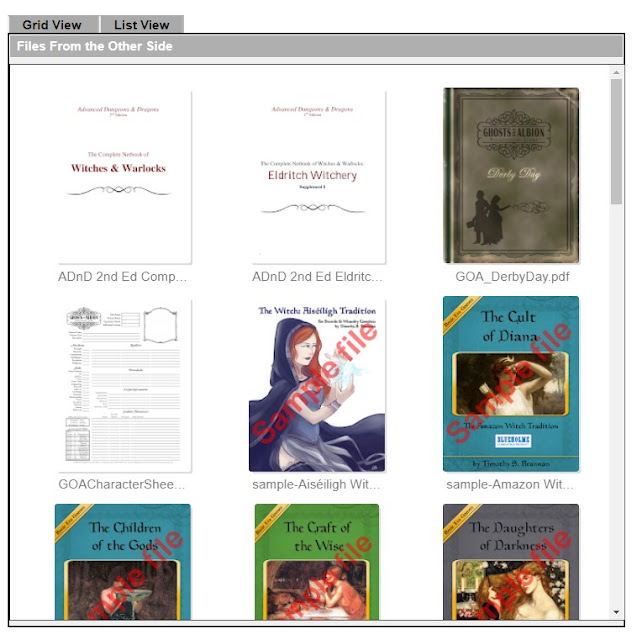
Well I spent some time on it yesterday and now I have it working with Google Drive.  And because I am never satisfied with just a link, there are Grid View and List View windows to see all the files.

Downloads

I figure since I spent so much time on the code for this I should add a few things.

So I included the PDF previews of all my witch books on DriveThruRPG. There are few files that Eden studios have given me permission to host/share and I figured, what the hell, there are a few of my AD&D 2nd Ed "Netbooks" there.  You can find my original "Complete Netbook of Witches & Warlocks" as well as the AD&D 2nd Ed Priest Kit, the Sun Priest here. 

The Sun Priest shares DNA with the witch as one of the classes I created back in my earliest days of gaming.  The Healer and Necromance complete the quad.  One day I really should finish up that healer class.

I also included the free "Basic" and "S&W" witch character sheets here and a copy of the AD&D Tournament scorecard I have used in the past.

I will be adding to this as I can.  If there are enough files then I'll start a nested folder structure, but right now there are only 30 odd files here.

One thing I *will* add are the Google Sheets of the witch spells I have made.  This help people figure out which witch book they want to buy and if anyone needs an OGC spell they now know where to look.

Let me know if there is anything you would like to see added to this.

Tuesday, January 30, 2024

Character Creation Challenge: Magnus Ulslime for Wasted Lands

 Heroes are often measured by the bad guys they have to face. If that is the case then Johan Werper and his line are true heroes indeed because their long time foe is a semi-immortal necromancer of the darkest dye. And you have seen him before.

Magnus Ulslime character sheets

Magnus Ulslime had several origin points for me that all seemed to collide at once. First there was Len Lakofka's Death Master class I saw in Best of Dragon Vol. III, a reprint of his class from Dragon #76. There was Ulslime the Chaosar (terrible name) from Module CM2 Death's Ride. And finally what I *thought* Module X6 Quagmire was about. All of these mixed in the same vat I was building classes in; my Healer, Sun-Priest, Witch, and Necromancer.  I saw my Necromancer as the moral opposite of the Healer and the Sun Priest.  Eventually, I would go to get my Profane Necromancer and Death Pact Warlocks out into the world along with my Witch.

Much like Larina is my test character for anything witchy, Magnus is my test for any sort of necromancer. Though I do not have as many versions of him as I do her.  I have featured him, though, as Necromancer for Spellcraft & Swordplay and as a Death Pact Warlock. I have also done his adopted children Runu and Urnu for both Spellcraft and Swordplay and Wasted Lands in the past. 

Magnus Ulslime
Magnus Ulslime

Class: Necromancer
Level: 13
Species: Human
Alignment: Dark Evil
Background: Cult

Abilities
Strength: 10 (+0) 
Agility: 13 (+1) 
Toughness: 14 (+1) 
Intelligence: 19 (+3) N
Wits: 16 (+2) N
Persona: 19 (+3) Z

Fate Points: 1d10
Defense Value: 5
Vitality: 87
Degeneracy: 33
Corruption: 7

Check Bonus (A/N/D): +7/+4/+3
Melee Bonus: +2 (base)
Ranged Bonus: +2 (base)
Magical Attack: +2
Saves: +8 to Persona saves, -2 vs Corruption

Cult Powers
Commune with Deeper Dark (1/week), Familiar (small demon), Forbidden Knowledge 38%, Mystical Senses

Necromancer Abilities
Channel the Dead, See Dead people, Turn Undead, Protection from Dead x5, Summon the Dead, Vampiric Augmentation, Suggestion x2, Command, Vampiric Touch, Beguile Spirit

Arcane Powers
Detect Thoughts, Polymath (Sage Abilities: Level 1), Incubus (touchstone), Shadow Walk (touchstone)

Spells
First level: Black Flames, Night Vision, Glamour
Second level: Invoke Fear, Paralyze Poison

Heroic/Divine Touchstones 
1st Level: Arcane Power: Incubus (1d6)
2nd Level: Arcane Power: Shadow Walk
3rd Level: Class Level, Sorcerer 1
4th Level: Class Level, Sorcerer 2
5th Level: Class Level, Sorcerer 3
6th Level: Class Level, Sorcerer 4
7th Level: Character ceases to age

Heroic (Divine) Archetype: Death

Gear
Death staff

Magnus in the Wasted Lands

These are great stats and I am amazed with how flexible and customizable this game actually is. There is just so much going on here. It is also the first time in a character write-up I was able to really capture his childhood in a Death Cult. The only thing I did not do here is capture his early adulthood as a druid. Maybe a couple of levels of Theosophist would cover that.

Magnus in NIGHT SHIFT

If the Dark Druid can make it to the modern age, then Magnus could as well. I can see a cult trying to bring him back. I see it as sort of like a cheesy 80s movie where a bunch of teens play some record backward and summons Magnus, though I think to be true to his roots AND the 80s, he would have to be called "The Death Master."  Hmm. Maybe this is the missing piece of this 80s adventure I have been wanting to do.

Magnus in Thirteen Parsecs

I honestly have no idea if he will live this long. But maybe I will come up with something. The universe is a big and really weird place.  Though I will admit the name "Magnus" came to me while watching the Doctor Who serial "Talons of Weng-Chiang."  The bad guy in this one, Magnus Greel, was from the 51st Century. He even had a familiar of sorts, Mr. Sin.  I might have to name his quasit familiar Mr. Sin.

You can get the Wasted Lands RPG and the NIGHT SHIFT RPG at Elf Lair Games. Thirteen Parsecs is coming soon.

Character Creation Challenge

Wednesday, June 1, 2016

Class Struggles: The Cleric

Coming back to my Class Struggles series I wanted to look into the class that really got me thinking about this series to start with.  The Cleric.

There has been a lot of talk of clerics and their value in a D&D game.  This ranges from the old school of whether or not the Cleric is an appropriate trope for a fantasy game to the new school of whether a cleric is needed in a game that also has healing from long rests.

I am firmly in the camp of Clerics are as much a part of D&D as Fighters, Wizards and Thieves.

My first character ever was Father Johan Werper, Cleric of the God of the Sun, Hunter of the Undead. He was a bit of a generic cleric to be honest, and I choose the sun god because I thought that as a quasi-medieval priest  the sun would be a major feature of all the is holy, bright and good.  Plus I had been reading a bunch of Greek Myths and I thought Apollo would make for a good god.  But the real reason I choose the cleric; Turning Undead.  That was an AWESOME power in my pre-teen mind.   So that has colored my views of the cleric ever since.
(Father Werper, now St. Werper, lives on as an official Saint in COA04: Guidebook to the Duchy of Valnwall.)

In real life I am an atheist, but I like the play the religious character.  So clerics, witches, druids, all fascinate me.  But clerics are where it all started.

Clerics as Occult Researchers


In nearly every other game I have ever played there have been occult researchers.  There is usually someone that is the party's muscle, the magic-guy, the sneaky guy and the smart guy.  Sometime the magic guy and smart guy are the same, sometimes though they are not.  The Cleric takes on the roll of the Smart Guy or the Occult Researcher.  The books, the ill-fitting glasses, and the wisdom to know what to do is the role of the cleric.

It is fairly well known that the idea behind clerical undead turning  came from Peter Cushing's Van Helsing characters in the various Hammer Dracula films.  Why not extend the metaphor to include the rest of Van Helsing's portfolio.  As a class that puts a high value on Wisdom then the cleric should be a font of knowledge. Sure, this can also be done by the Magic-User / Wiazard,  but the cleric's input should not be understated.  Van Helsing is described as a meta-physian or what we might call a poly-math, or man of letters.  Wizards, even with schools, don't have the same "Academic" credibility as a cleric can have.  Sure the shaman could be considered a cleric in some games, and his schooling could entirely be natural or at least un-scholastic in nature.

In D&D 3, 4 and 5 knowledge of the undead fall within the Knowledge (Religion) or just Religion category.   These characters tend to have more training in this area than other characters.  While wizards are typically the font of magical knowledge, clerics should be the source of knowledge beyond the ken of mortal man and into the realm of the gods and other forms of the supernatural.

Clerics as the Party Leader
The cleric also can serve the role as the leader. While the cleric can run the gamut of influential high priest to crazy street prophet to diabolic cult leader, players typically take on the role of the cleric of the local church, usually good.  Certainly that is what D&D wants you to do and that is fine.  This type of cleric also works as the default leader, whether he/she is or not. So if this is the hand you are dealt, then play it because clerics make great leaders. Under most circumstances they access to power, money, a hierarchy and can expect a modicum of respect from the locals.  All this adds up to an instant authority figure.  Even if they are not.
While this role was stress fairly heavy in D&D4, all other versions of the game also give it tacit, implicit and even explicit lip service.  In D&D5 the divine domains of Knowledge and War make for pretty good leader types. Their better saves in Wisdom and Charisma make them less likely to charmed or otherwise controlled magically, so this can be role-played as a stronger than average mental fortitude.  Which fits the cleric well.

Cleric as the Party Medic
The obvious role.  Clerics have healing magic in earlier editions of the game, have spontaneous healing spells in the 3.x era and can activate healing surges in 4th. The clerics of 5th edition seem to take them back more to their roots in terms of healing.  The role of the cleric cannot be overstated.  Parties without a cleric die.
During my run between 1st and 2nd Ed I created a Healer class.  It shared a number of features that my Witch class did including the ability to heal by touch as she went up in level.  Completely unneeded in 3.x of course, but in 2nd Ed it was quite a game changer.  I also made an NPC healer a pacifist.  She would never raise a weapon to any creature unless of course it was undead and then she went all Peter Cushing on them.  But running that class and character (she was the only character I ever made for that class) showed me how important the healing aspect was.  There was not just the regaining hit points, there was the player morale.  Also, since the character was an NPC it was easy not to have her fight, but the Players really did everything they could to protect her.

BTW. Her name was Celene Weper and she was the grand-daughter of Father Werper above.  Yes clerics in my world get married and have kids, since it is a life-affirming thing.
Plus keep in mind that Clerics as Healers have a long tradition even in our own world.  If ever a character decided to become a pure healing cleric and take an oath of non-violence then I would give them XP for every hitpoint cured and a share of combat XP.  I would also give them 2x the starting funds (even though they would give what they don't spend back to the church) to represent the investment their churches/hospitals have made in them.  After all, can't send a healer out into the world with shoddy armor. Reflects bad on their organization.

Clerics as Combatants?
It almost seems counter to the above, but clerics are the second best major class when it comes to fighting.  Only fighters (and their related classes) are better.  The get good saves vs. magic due to their high wisdom, or Will saves for the same reason and their saves are pretty decent to start with.   Plus they have one thing fighters don't have, the  ability to use magic.  "So what" you say, "so can Wizards and even your favorite witch."  Yes, but can they do it in field plate armor?  Clerics can.  Sure they do not get the combat spells the wizard gets, but they have a few good ones too.  Creeping Doom is a nasty little spell for Druids.  Finger of Death and reversed Heal spells can also ruin someone's day.

In games without Paladins, Clerics are the "righteous fist of (their) god".  Wizards don't smite.
Clerics can also be one of the few character types that can actually kill monsters with-out the moral hangups.  Even fighters, who get paid, and thieves, that might be working as assassins, don't get the same kind of "get out of jail free card" as do clerics operating within the doctrines of their faith and church.  Think back to the Crusades and the Inquisition, the faithful got away with murder, torture and even more horrible crimes in the name of their God and the law had little to say about it or were in collusion with them.

Clerics might then be one of the more well rounded characters in the group.

Friday, May 6, 2011

Clerics in D&D

There has been a lot of talk of clerics and their value in a D&D game.  This ranges from the the old school of whether or not the Cleric is an appropriate trope for a fantasy game to the new school of whether a cleric is needed in a game that also has healing surges.

Here are some posts to illustrate what I mean,
http://www.wizards.com/dnd/article.aspx?x=dnd/4ll/20110426
http://www.wizards.com/DnD/Article.aspx?x=dnd/4ll/20110503#74170
http://lawfulindifferent.blogspot.com/2011/04/god-i-hate-clerics.html
http://daegames.blogspot.com/2011/04/who-wants-to-play-cleric_26.html
http://theresdungeonsdownunder.blogspot.com/2011/05/making-cleric-cleric-blank-religion.html

I am firmly in the camp of Clerics are as much a part of D&D as Fighters, Wizards and Thieves.

My first character ever was Father Johan Weper, Cleric of the God of the Sun, Hunter of the Undead. He was a bit of a generic cleric to be honest, and I choose the sun god because I thought that as a quasi-medieval priest  the sun would be a major feature of all the is holy, bright and good.  Plus I had been reading a bunch of Greek Myths and I though Apollo would make for a good god.  But the real reason I choose the cleric; Turning Undead.  That was an AWESOME power in my pre-teen mind.   So that has colored my views of the cleric ever since.

In real life I am an atheist, but I like the play the religious character.  So clerics, witches, druids, all fascinate me.  But clerics are where it all started.

Clerics as Occult Researchers
In nearly every other game I have ever played there have been occult researchers.  There is usually someone that is the pary's muscle, the magic-guy, the sneaky guy and then the smart guy.  Sometime the magic guy and smart guy are the same, sometimes though they are not.  The Cleric takes on the roll of the Smart Guy or the Occult Researcher.  The books, the ill fitting glasses, and the wisdom to know what to do is the roll of the cleric.

It is fairly well known that the idea behind clerical undead turning  came from Peter Cushing's Van Helsing characters in the various Hammer Dracula films.  Why not extend the metaphor to include the rest of Van Helsing's portfolio.  As a class that puts a high value on Wisdom then the cleric should be a font of knowledge. Sure, this can also be done by the Magic-User / Wiazard,  but the cleric's input should not be understated.

In D&D 3 and 4 knowledge of the undead fall within the Knowledge (Religion) or just Religion category.   These characters tend to have more training in this area than other characters.  While wizards are typically the font of magical knowledge, clerics should be the source of knowledge beyond the ken of mortal man and into the realm of the gods.

Clerics as the Party Leader
The cleric also can serve the roll as the leader. While the cleric can run the gamut of influential high priest to crazy street prophet to diabolic cult leader, players typically take on the roll of the cleric of the local church, usually good.  Certainly that is what D&D4 wants you to do and that is fine.  This type of cleric also works as the default leader, whether he/she is or not. So if this is the hand you are dealt, then play it because clerics make great leaders. Under most circumstances they access to power, money, a hierarchy and can expect a modicum of respect from the locals.  All this adds up to instant authority figure.  Even if they are not.

Cleric as the Party Medic
The obvious role.  Clerics have healing magic in earlier editions of the game, have spontaneous healing spells in the 3.x era and can activate healing surges in 4th.  The role of the cleric cannot be overstated.  Parties with out a cleric die.
During my run between 1st and 2nd Ed I created a Healer class.  It shared a number of features that my Witch class did including the ability to heal by touch as she went up in level.  Completely unneeded in 3.x of course, but in 2nd Ed it was quite a game changer.  I also made an NPC healer a pacifist.  She would never raise a weapon to any creature, unless of course it was undead and then she went all Peter Cushing on them.  But running that class and character (she was the only character I ever made for that class) showed me how important the healing aspect was.  There was not just the regaining hit points, there was the player morale.  Also since the character was an NPC it was easy not to have her fight, but the Players really did everything they could to protect her.

BTW. Her name was Celene Weper and she was the youngest daughter of Father Werper above.  Yes clerics in my world get married and have kids, since it is a life affirming thing.
Plus keep in mind that Clerics as Healers has a long tradition even in our own world.  If ever a character decided to become a pure healing cleric and take an oath of non violence then I would give them XP for every hitpoint cured and a share of combat XP.  I would also give them 2x the starting funds (even though they would give what they don't spend back to the church) to represent the investment their churches/hospitals have made in them.  After all, can't send a healer out into the world with shoddy armor. Reflects bad on their organization.

Clerics as Combatants?
It almost seems counter to the above, but clerics are the second best major class when it comes to fighting.  Only fighters (and their related classes) are better.  The get good saves vs. magic due to their high wisdom, or Will saves for the same reason and their saves are pretty decent to start with.   Plus they have one thing fighters don't have, the  ability to use magic.  So what you say, so can Wizards and even your favorite witch.  Yes, but can they do it in field plate armor?  Clerics can.  Sure they do not get the combat spells the wizard gets, but they have a few good ones too.  Creeping Doom is a nasty little spell for Druids.  Finger of Death and reversed Heal spells can also ruin someone's day.
In games without Paladins, Clerics are the "righteous fist of (their) god".  Wizards don't smite.
Clerics can also be one of the few character types that can actually kill monsters with out the moral hnagups.  Even fighters, who get paid, and thieves, that might be working as assassins, don't get the same kind of "get out of jail free card" as do clerics operating within the doctrines of their faith and church.  Think back to the Crusades and the Inquisition, the faithful got away with murder, torture and even more horrible crimes in the name of their God and the law had little to say about it or were in collusion with them.

Clerics might then be one of the more well rounded characters in the group.

Wednesday, January 28, 2015

Checking in on my Plan

Over the years I have discussed my Plan.  The Plan is what adventures I am going to take my kids through.

For D&D 3.x I was content to take anything as it came, make stuff up and generally going towards a  stopping the cult of Tiamat plot.  It was/has been fun and we are nearing the end of that.

For the new adventures I was looking at 3rd, then 4th, then 1st and now 5th Edition as the primary game system.

http://timbrannan.blogspot.com/2010/01/i-have-plan.html
http://timbrannan.blogspot.com/2012/02/lets-play-1st-ed-dad.html
http://timbrannan.blogspot.com/2012/07/my-kids-are-awesome.html

At the present here is where I am.
  • B1 Into the Unknown, levels 1-3
  • B2 Keep on the Borderlands, levels 1-3
  • L1 The Secret of Bone Hill, levels 2-4
  • X2 Castle Amber, levels 3-6 (where we are now!)
  • I6 Ravenloft, levels 5-7
  • A0-5 Slave Lords, levels 4-7
  • G123, Against the Giants, levels 8-12 (I also have the Stone Giant one from Dragonsfoot, just need to find it)
  • D12,3 Against the Drow, levels 8,9-14
  • Q1 Queen of the Demonweb Pits, 10-14
  • CM2 Death's Ride, levels 15-20. (Again, unless I use it in my current 3.x game which the boys want me to do)
If I don't do Death's Ride I am seriously considering the classic H series to go after Orcus.
  • H1 Bloodstone Pass, levels 15+
  • H2 The Mines of Bloodstone, levels 16-18
  • H3 The Bloodstone Wars, levels 17-20
  • H4 The Throne of Bloodstone, levels 18-100
But I would REALLY edit these since they have a lot of issues.  Truthfully my best plan is to just use H4 and add bits from H1-3 and maybe even some stuff from the 4th Ed E-Series.  But that is if I want to have Orcus as the big bad guy at the end.  It has appeal.

Also I have the mind flayer adventure A Darkness Gathering to work into the mix.

It has taken me a while to get through all this because I am alternating with my 3.x game, some AS&SH and other games.

So far the adventures have seemed random and the characters are wandering about.  But they are about to get some items in the X2/I6 series that will help them later on.  

Right now, with out their knowing about it the Drow, Vampires and Illithids have gathered together to put the final phase of their ultimate plan into motion.  The PCs will discover a little of this plan when they encounter the Slavers.  The slavers are all vampires now and they are not dealing in slaves, but human cattle.    After they have defeated them the last part of the bad guys plan comes into fruition.  

The sun goes completely out.  

There is panic. Everyone gathers in the Freecity of Greyhawk.  The Church of Pelor/Ixion is hardest hit, but also the loudest voice.  All the "big names" are there and they are trying to figure out what to do.
There is a plan to set the moon a flame, but the various clergy of the Moon Goddesses are against that.  Finally they agree to instead use a large asteroid to keep life going till they can re-ignite the sun.
While all the big names are trying to figure this out the PCs have to deal with some raids nearby of giants...

The PCs will then go through the GDQ series to discover the plan and that the drow are working with mind flayers.  After defeating Lolth in Q1 the PCs will have to deal with the vampires who have Pelor captured.  In order to re ignite the sun they will need to set him free from his prison in ..... and that is all I have.

Yeah it is kinda story-gamey.  It's my game, my house and my kids. They will eat this up.
I guess it is hard for me to get away from the idea of vampires as the big bads.

Those of you who have been reading this blog a long time might notice that there was a similar plot in my Buffy Season 7 game, Episode 12 No Other Troy.  Though that one the sun being blocked was a side effect. 

I am inclined to use Orcus as the big bad holding Pelor.  
I have a huge ass mini of him and a crap ton of material for him.

But I have also wanted to use Camazotz as the demon-god of Vampires in his abyssal plane of Xibalba.  Maybe I still can use him in some way.  It is possible he is something like a high priest to Orcus and his job is to sacrifice Pelor on a bloody altar.  Once that is done Orcus will suck up his godly powers and reign as the God of Death and Darkness.

And he would have gotten away with it too had it not been for those meddling PCs.

Sunday, April 7, 2024

Larina Nix for Advanced Dungeons & Dragons 2nd Edition

Larina by Beatriz Sanguino
Again, I'm surprised I haven't posted something like this already. Given that I talked about AD&D 2nd Edition earlier today, I thought this might be a good time to discuss the different witches from the AD&D 2nd Ed era. 

I have talked in the past about how the AD&D 2nd edition era was a good time for all sorts of witch classes. By my count, there were at least four official classes from TSR (and later WotC) for AD&D 2nd Ed, and quite a few unofficial ones. 

I have compared a few witch classes with each other at varying levels of detail over the years and will likely do it more when I take my deep dive into the Forgotten Realms for AD&D 2nd Ed. But looking back, I see I never taken the time to compare the AD&D Second classes to each other. The closest I have come was comparing two AD&D 2nd Characters to each other, Nida and Sinéad, and Sinéad is no longer even a proper witch. 

One day, I'll do more, but I want to look at one official witch and two unofficial ones for today.  I think I'll save Nida when it comes time to discuss the other official witches. Plus, using Larina here is much more appropriate. 

As I mentioned earlier today, AD&D 2nd Edition can be seen as an extension or continuation of the AD&D 1st Edition line. The games are very compatible. So, my characters often moved from 1st to 2nd Edition without so much as getting a new sheet. Larina here is no exception. She began in 1986 with AD&D 1st Ed and moved to AD&D 2nd Ed in 1989 without a blink. But I did make new sheets for her eventually.

Let's go back a bit before AD&D 2nd edition came out. Back in July 1986, I created a witch character, Larina, to test some ideas I had about doing witches in (A)D&D. When Dragon Magazine came out in October of 1986 I started using that. But all the while, I am collecting my notes and ideas. Moving forward to 1989, AD&D 2nd Edition was released. There were a lot of new ideas in that and I was looking forward to trying out my collected notes. One set of notes became my Sun Priest kit for Clerics, another became a pile of notes for the Healer, another the Necromancer/Death Mage, but the largest would become the Witch. It would be almost 10 years before it would see publication but it did and Larina was a central figure in that work.

In those 10 years, there was a lot of writing and playtesting. 

While I kept my Dragon #114/AD&D1st ed witch version of her, I created a parallel version using my new witch rules. This version was supposed to be the same person, just with a different set of rules to govern her. While that happened, two other witch classes were published to help me make other choices. I also set her up for these rules and played all three (or four, really) versions to see how she worked in different situations.  So, if you have ever wondered if I have run out of things to say about witches or even this witch in particular, the answer is no, I have spent more hours with her than any other character I have.

So I would like to present her for AD&D Second Edition, but three different witch classes.

Various AD&D 2nd Ed Witches

Larina Nix for AD&D 2nd Edition

This version(s) of Larina is just the continuation of her AD&D 1st Edition incarnation.

Base Stats (same for all versions).

Larina Nix
Human Witch, Lawful Neutral

Strength: 9
Dexterity: 17 
Constitution: 16
Intelligence: 18 
Wisdom: 18
Charisma: 18

Movement: 12
AC: 1
HP: 86

Weapons
Dagger, Staff

Defenses: Bracers of Defense (AC 1)

Languages: Common, Alignment, Elven, Dwarven, Dragon, Goblin, Orc, Sylvan
Ancient Languages: Primordial, Abyssal, Infernal

So, in this version, her dex and con were raised by some magic.

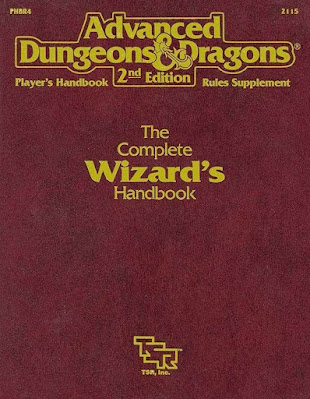
The Complete Wizard's Handbook

Class: Wizard
Kit: Witch
Level: 15

Saving Throws (Base)
Paralyze/Poison/Death: 11
Rod, Staff, Wand: 7
Petrify/Polymorph: 9
Breath Weapon: 11
Magic: 11

THAC0: 16

Proficiencies: Ancient History, Astrology (2), Herbalism, Reading/Writing (4), Religion (2), Spellcraft (4), Animal Handling, Artistic.
Weapons: Dagger, Staff

Secondary Skill: Scribe

Powers
3rd level: Familiar
5th level: Brew Calmative
7th level: Brew Poison
9th level: Beguile
11th level: Brew Flying Ointment
13th level: Witch's Cure

Spells
1st level: Burning Hands, Charm Person, Comprehend Languages, Copy, Chromatic Orb
2nd level: Blindness, ESP, Tasha's Hideous Uncontrollable Laughter, Knock, Ice Knife
3rd level: Clairvoyance, Hold Person, Hovering Skull, Iron Mind, Pain Touch
4th level: Dimension Door, Fear, Magic Mirror, Remove Curse, Fire Aura
5th level: Advanced Illusion, Cone of Cold, Feeblemind, Telekinesis, Shadow Door
6th level: Eyebite, Dragon Scales
7th level: Shadow Walk

--

Mayfair Role-aids: Witches

Class: Witch / Wizard
Tradition: Classical
Level: 15 / 1

Saving Throws (Base)
Paralyze/Poison/Death: 13
Rod, Staff, Wand: 9
Petrify/Polymorph: 11
Breath Weapon: 13
Magic: 10

THAC0: 16

Proficiencies: Ancient History, Astrology (2), Herbalism, Reading/Writing (4), Religion (2), Spellcraft (4), Animal Handling, Artistic.
Weapons: Dagger, Staff

Secondary Skill: Scribe

Powers
Herbalism

Spells
1st level: Feather Fall, Identify, Read Magic, Sleep, Chill Touch, Protection from Evil, Color Spray
2nd level: Flaming Sphere, Locate Object, Forget, Ray of Enfeeblement, Strength
3rd level: Cure Light Wounds, Dispel Magic, Clairvoyance, Delude, Mystery Script
4th level: Call Lightning, Fear, Fire Shield, Magic Mirror, Wall of Fire
5th level: Feeblemind, Shadow Magic, Dream, FAlse Vision
6th level: Geas, Legend Lore, True Seeing
7th level: Shadow Walk

--

Mayfair Role-aids: Witches
The Complete Netbook of Witches & Warlocks

Class: Witch (Priest Sub-class)
Level: 15

Saving Throws (Base)
Paralyze/Poison/Death: 5
Rod, Staff, Wand: 9
Petrify/Polymorph: 8
Breath Weapon: 11
Magic: 10

THAC0: 12

Proficiencies: Ancient History, Astrology (2), Herbalism, Reading/Writing (4), Religion (2), Spellcraft (4), Animal Handling, Artistic.
Weapons: Dagger, Staff

Secondary Skill: Scribe

Powers
1st: Turn Undead
3rd level: Read/Detect Magic
6th level: Chill Touch
9th level: Candle Magic
12th level: Immune to Fear
15th level: Fascination
11th level: Brew Flying Ointment
13th level: Witch's Cure

Spells
1st level: Create Fire, Katarine's Dart, Witch Light, Dowse, Wall of Darkness, Painful Wounds
2nd level: Burning Wind, Acquire Witch's Familiar, Blackfire, Dance Trantra, Minor Hex, Pain Armor, Protection vs. Elementals
3rd level: Lesser Strengthing Rite, Beguile III, Astral Sense, Lethe, Witch Writing, Rite of Remote Seeing
4th level: Spirit Dagger, Cloak of Shifting Shadows, Broom, Cleanse, Card Reading, Grandmother's Shawl, Middle Banishing Rite
5th level: Rite of Magical Resistance, Starflare, Dolor, Bull of Heaven
6th level: Anchoring Rite, Greater Banishing Rite, Kiss of Life
7th level: Demon Trap

--

The biggest differences are in the powers and the spells. 

I kept her HP the same in all three cases to keep combat a fixed variable, the same with her weapons and non-weapon proficiencies. 

The Wizard's Handbook from TSR strikes a good balance of powers and spells. The Mayfair Role-aids Witches book has some great spells. Of course I am fond of my own Complete Netbook of Witches & Warlocks. Of course, after 25 years, there are things I would do differently now.

Playing All Three

Playing all three in a game was interesting but also a lot of fun. I'd generally alternate between them, choosing which one to use in combat beforehand so I could measure the utility of the spells. So when I say I have played her more than any other character, I really mean it. I kept her "real" sheets as notes in MS Word 2.0/95/97 to make easy changes to them as I played with my CNoW&W one as the "official" character sheet. 

This also gave me the idea that all her incarnations are aware of each other. It has nothing to do with any of the game mechanics I have written, but it is aa fun little role-playing exercise. 

In 1999, on October 31st, I was sitting in the hospital. My wife had just had our first baby, Liam, and I had my laptop. Just after midnight, I released my "The Complete Netbook of Witches & Warlocks" for free on the web. Larina was featured in that book as a 6-year-old who discovered she was a witch.

All the playtesting would then lead to my "The Witch: A sourcebook for Basic Edition fantasy games" released exactly 14 years later.  It would also lead to my 3rd Edition books on witches, but I'll talk about them next week.