Showing posts with label OMG. Show all posts

Wednesday, July 22, 2026

Witchcraft Wednesday: The Threefold Goddess Tradition

 With Advanced Witches & Warlocks, I have had in mind a certain goal: to give the witch traditions the weight of actual occult practice. I do not want it to be a matter of "this witch has fire, that one has healing." There is more to it than that; it is about how one comes to terms with magic and divinity, with their coven, the world, and the self.

In pursuit of that, I have been drawn back to an old friend of my witch material, the Triple Goddess.

"Maiden, Mother, Crone" by Ben Honeycut

For some time now the Maiden, Mother and Crone have served as my way of putting the threefold form of the Goddess into words. It is a familiar shorthand that says something essential about the craft. Yet as I put in the work on Advanced Witches & Warlocks, I came to see that this was no longer an idea or conjecture to be just a background notion. It could stand as a tradition in its own right.

Hence The Threefold Goddess Tradition.

It is not to be confused with a neo-Pagan convenience or the simple equation of witches worshipping Diana. Nor is it only a Triple Moon affair, though the moon holds center stage. What I am building is a framework, both magical and theological, by which a witch can make sense of many goddesses and many kinds of magic under one sacred pattern.

So I am going to steal a LOT from the Christian Trinity. Consider the contradiction:

The Goddess is the Maiden, the Mother, the Crone.

And yet the Maiden is not the Mother, nor the Crone the Maiden. All are the Goddess.

There is no problem with that. The point is precisely there. I am perfectly happy with contradictions.

I call it the Threefold Sign. One might be tempted to take the logic of the Shield of the Trinity diagram – where each is God but not the other, and apply it here. And the logic would hold up. But the visual language would be off. This is not Christian theology in a black dress with a moon pendant. It is witchcraft and requires a witch’s symbol.

So we use something on the order of a triquetra, or three circles interlinked. In the overlap of two you will find their mysteries touching; where the three come together is the Mystery of the Goddess herself, beyond any name.

Triquetra

Some covens will inscribe the words Maiden, Mother, Crone in those circles. Others will put the names of goddesses there, or three moons (crescent, full, dark), or perhaps three ravens, three keys, three wells. The symbol is meant to instruct the initiate that while the Goddess is whole, her faces are not to be conflated. The Crone is not simply an aged Mother, nor the Maiden a young one. They are distinct, they are complete, they are divine. They are unique and they are unified. Like I have said before, I like my gods messy.

To treat it as a puzzle is to miss what is happening. It is a mystery for the witch to enter into.

The most usual expression of the tradition, of course, is to honor the Goddess as Maiden, Mother and Crone. 

One might call the Maiden the start of things. She is the first step and the new moon, the road left untraveled. She is the huntress and the girl in the woods, the rebel and the initiate, the question put to you that no one wishes to hear. There is a danger in her youth; she is not without power but is perilous in her becoming. The Maiden is the threshold and the keeper of the threshold. Through her there is deeper understanding of the beginning. 

The Mother represents fullness. Think of the full moon, the hearth, or the field. She is the queen and the lover, the teacher and the protector, the witch at the coven’s heart. She has the power to create and to bless, yet do not mistake her for being soft. Those who consider the Mother harmless have never been on the receiving end of a mother defending her young.

Then there is the Crone, the ending and the memory. She is the waning and dark moon, the graveyard and the crossroads, the winter and the final spell. She is the truth from which there is no escape. Feared for what she knows and honored for what she remembers, she is the keeper of ghosts and curses and all final wisdom.

In concert they are the cycle of birth, life, death and rebirth. It is a cosmology I have used for a very long time. Witches do not tend to view death as some sort of reward or punishment; to them it is part of the great turning, along with rest and rebirth. The Crone is not an end to the story so much as the one who readies the soul to start over. This is also the same reason why my witches can't be raised from the dead.

I have found a particular utility in what I term the Lunar Mask. In my campaign notes, there was a moon-priestess who came to see a deeper pattern in the goddesses she revered. She did not forsake her faith, but understood her goddess to be but one aspect of something older and more complete.

For Advanced Witches & Warlocks I cannot employ deity names from other published settings, though I have no need to. Our own real-world mythic structure is far superior. So for the Lunar Mask I have settled on:

Diana as the Maiden. The crescent moon and the silver bow. She is the wild wood and the fierce independence of the untamed, the arrow in the dark and the way into the forest.

Selene as the Mother. The luminous presence and the dream-giver. She is the tide of blessing, the lover, the full moon shining down on everything.

Hecate as the Crone. The torch and the key, the ghost road and the witch-night. She is the figure at the crossroads where the living must make their peace with the dead.

This serves as a clean substitute for the triad in my own play and is more broadly useful for the book. It also allows for a clear delineation between the larger tradition and individual covens. One coven may give its honors to Diana, Selene and Hecate; another will have different names for the same Threefold Goddess Tradition.

Triple Hecate by William Blake

The Triple Moon Goddess Heresy

I find the notion all the more compelling here.

During a recent campaign discussion, I put forward the concept of a priestess who makes an unsettling discovery: the moon goddesses of her world are not distinct and unconnected powers as she has been taught. Rather, they are three aspects of some deeper lunar enigma.

The temples would call it heresy. The witch calls it revelation. One has to make that distinction. This is no case of a goddess making a thunderous appearance to confirm you are right, nor is it a tidy prophecy. It is a matter of scholarship and risk, of intuition and ritual. The priestess will pore over old songs for matching symbols or spot the same moon-shape in the carving above a long-forgotten door. She hears how a forbidden hymn in one temple is answered by the orthodox prayer of another. She starts to think the line drawn between the goddesses is not so much false as it is incomplete.

That is the sort of heresy I have for my witches. Where a cleric is content to uphold the temple’s version of the truth, a witch wants to know what the temple has left out.

In this way the "Triple Moon Goddess Heresy" can be made to work for the Threefold Goddess Tradition. It is not something every coven must accept, nor does it have to be true in every campaign. But it puts a fine tension on the tradition. For the Threefold Goddess is not simply a matter of old women in the woods with their rites; there is a dangerous theology to it. A witch-priestess might look at three rival temples and tell them they are all correct but have no idea why. That is very much in keeping with a witch.

Beyond the Moon

I am inclined to stick with The Threefold Goddess Tradition as the name precisely because I do not want to confine things to moon goddesses alone.

There really is no better symbol for the witch than the moon. It is the perfect sign in that it can change its shape and yet remain itself; it vanishes and comes back again. It is the ruler of tides, night, magic, madness, and fertility.  The connections are so deep and so ancient I'd be a fool to fight them.

But the Threefold Goddess is a bigger entity than the moon. Other covens will have their own triadic powers to honor her with. A Brigidine coven might see her in poetry, healing and smithcraft, three flames to one fire. Or a Morrígan coven in battle, sovereignty and prophecy, which is to say three ravens and one fate. A Hecatean coven could honor her at the road, the threshold and the grave; a mystery cult as maiden of descent, mother of grain and crone of the underworld. A coven of fates may view her as Clotho the Spinner, Lachesis the Measurer, and Atropos the Cutter. 

They are not the same coven, and they are free to disagree, even to charge one another with misapprehending the Goddess. Again, I have no objection to such contradictions when it comes to divinities. If anything, it gives the tradition an older, more vital feel.

The Daughters of Aradia

This also provides a good home for the Daughters of Aradia, a tradition I have been working on. I had considered them a tradition of their own, and they can still be, but this fits well enough. I have come to the view that they are better suited as a sub-tradition of the Threefold Goddess, or perhaps a coven of some power and mystery. In any case, their take on the threefold pattern is not the same as the Lunar Mask.

Under this arrangement, Diana is the Moon-Mother and wellspring of witchcraft; Aradia the Daughter, the liberator and teacher sent out into the world; Hecate the Crone, holding the night roads and what power is hidden from view. It is a more pointed and politically charged stance for the Daughters of Aradia. They are not simply moon witches but agents of resistance, secrecy and teaching. Their myth holds that mortals were given witchcraft to stand up to tyranny as much as to bless and heal. 

Do they get along with witches of the Lunar Mask of Diana-Celene-Hecate? Some might, others might think their way is right, and the other is a dangerous cult of apostates. Can't wait to have some arguments at my table on this. 

You will not find the quiet feel of a lunar coven of seers here, yet there is no reason both cannot exist under the wider umbrella of the Threefold Goddess Tradition. That is the kind of thing I am after in Advanced Witches & Warlocks. A tradition should be specific enough to give rise to strong covens and rivalries, but broad enough to serve as the basis for many characters and adventures.

Larina's Triple Goddess Tattoo
Using This in Advanced Witches & Warlocks

For the purposes of the book, I would make the Threefold Goddess Tradition one of the principal ones. Mechanically, its witches are adept at divination, protection, healing, charms, dream work, transformation, curses, and dealing with spirits. There is a synthesis and mystery to their power that you do not get with the rigidity of the High Secret Order, the wildness of faerie ways or the grimness of the Daughters of Baba Yaga.

Their special abilities ought to reflect the threefold nature:

  • The Maiden for courage, movement, discovery and warding off fear.
  • The Mother for fertility, guardianship, healing and the protection of the coven.
  • The Crone for prophecy, spirit speech, death-wisdom and defense against necromancy.

When a witch of this tradition reaches a certain level, she can call on the hidden center of the Threefold Sign. Not as Maiden or Mother or Crone but as the Goddess in her Mystery. It should be a rare and potent thing, bound up with the moon or some rite of initiation. Her highest Occult Power.

It also provides good material for roleplaying. A Threefold witch might be a midwife in one village and a forbidden priestess in the next. She could be put in the position of having to defend herself against accusations of heresy or syncretism, carrying three holy symbols and declining to offer clerics who want clean doctrine any explanation.

That is how I want to set witch religion apart from the clerical sort. Clerics have their temples and orders to serve their gods. Witches come to the divine through bloodlines, signs, dreams, and the mysteries of the coven, things that do not always conform to temple law. Witches are not just clerics with better fashion sense and killer eyeliner.

In the end, the Threefold Goddess is not three, nor is she one in any simple way. She is the Maiden, the Mother and the Crone. The moon is merely the sign by which we have learned to know her.

Three circles. One mystery.

Links

Wednesday, May 21, 2025

Witchcraft Wednesdays: Heqate, Queen of Heka and the Crossroads Eternal

 I am working on my next Myths & Monsters series, this time on the Ptolemaic Myths of the combined Greek and Egyptian pantheons of the Ptolemaic rule of Egypt. While the poster children for these myths are Serapis and Hermes Trismegistus, I want to focus on a goddess who is, as far as I know, fairly unique.

While I am leaning heavily on academic scholarship here for this one, that only takes me so far. And in truth, if I am going to come up with my syncretic god here, it might as well be a Goddess of Witchcraft and Magic. 

Thankfully, one such goddess sprang, fully formed like Athena, from my mind. Or very nearly fully formed. 

Hecate, Heqet, Heka, and Hekau

Heqate, Queen of Heka and the Crossroads Eternal

This Wednesday, I want to return to the Ptolemaic Myths specifically, to the goddess known as Heqate (formerly Heka here), the Witch Queen of the Two Lands and the living embodiment of heka. This is not simply Hecate with great eyeliner, nor Heqet with a torch and dogs, nor even a distaff Heka or a Greek Weret Hekau. This is a syncretic goddess of magic, liminality, birth-life-death-rebirth, and arcane will, forged where Greek moon sorcery meets Egyptian divine speech.

If you've ever wanted to play a moonlit necromancer-priestess, a midwife-witch who communes with ghosts, or a seer whose scrolls bleed truth, this is your goddess. 

Heqate: The Torchbearer of the Threshold

In older Greek traditions, Hecate was already something liminal, goddess of the crossroads, of the moon, of ghosts, and witchcraft. And, of death, the ultimate threshold. In Egypt, the frog-headed Heqet presided over childbirth, resurrection, and divine protection in the womb and tomb alike. Add to this the Egyptian concept of heka (lower case, not the god Heka), not magic as trickery, but as cosmic creative force, and Weret Hekau, the Egyptian personification of supernatural powers, you get something entirely new. 

In the Ptolemaic imagination, these figures blur into one divine presence:

Heqate, the Queen of Witches, the Scribe of Names, the Midwife of Magic.

  • She carries torches of silver flame, revealing the paths between life and death and rebirth.
  • She speaks true names, unraveling illusions, enchantments, and lies.
  • She presides over birthing chambers and funerary rites, the first breath and the last silence.
  • Her voice is heka, and her will becomes ritual law.

The Three Faces of the Liminal Witch

Followers of Heqate often describe her as having three aspects (I can't resist a good Maiden-Mother-Crone tri-aspect):

  • The Maiden of Moonlight – Patron of seers, dreamers, and witches-in-training. She guards hidden knowledge and initiations.
  • The Mother of Torches – Midwife and ward-breaker. She protects the soul at its most vulnerable.
  • The Crone of Ash and Word – Keeper of forbidden names and the judgment of oaths. Her word is binding.

Temples and covens devoted to her often use three altars—one facing the door, one the hearth, and one a mirror.

Final Thoughts

Heqate isn’t just a rebranding. She’s a bridge goddess, walking between systems, just as witches walk between divine and arcane, mortal and otherworld, life and death. She offers you a chance to center magic not as firepower, but as language, ritual, and transformation.

The Ptolemies ruled over Egypt as Greek-speaking elites, and their greatest symbol wasn’t a weapon or a crown, it was a library. The Great Library of Alexandria was the beating heart of the Ptolemaic worldview: knowledge as power, preservation as control, language as law.

If Hermes Trismegistus is the figurehead of recorded wisdom, the scholar-priest who catalogues and measures, then Heqate is the figurehead of forbidden wisdom and occult knowledge, the whispered name, the unwritten charm, the scroll burned before it can be copied. She is the sorcerous opposite to Hermes’ alchemical order, not in opposition, but in complement. They are a cosmic argument between forms of knowing.

Do they oppose each other? Perhaps. No more than witches and wizards clash in how they practice magic. Perhaps this ancient rivalry echoes across the ages, playing out in coven and tower, scroll and staff, moon and mercury.

In any case, it is certainly a fun way to set up a god rivalry between wizards and witches in your worlds. 

And if I am being honest. She would have great eyeliner and wear an ankh as a necklace. 

Monday, May 19, 2025

Monstrous Mondays: Hippalektryon

Hippalektryon
 I am back to work on my next set of syncretized myths, this time my poster child of syncretism, the Greco-Egyptian gods, also known as the Ptolemaic Religion.  I am taking some of the historically documented gods (Hermes Trismegistus, Serapis, Harpokrates) and mixing in my own takes (Heka, Hermanubis), and others to round this set of myths out.

There are a few monsters that fit both the Greek and Egyptian myths very well. The pegasus (as a winged horse), the sphinx, giant snakes, giant scorpions, all sorts of undead. But there are some monsters common to both cultures (Ancient Greece, Ancient Egypt) that could also be used. Here is one. The Hippalektryon is an interesting creature. Since it is the combination of two creatures I decided they are sacred to Hermes Trismegistus.

Since my Myths & Monsters series is for 1st Edition, here it is in that format.

HIPPALEKTRYON

Rooster-Horse Hybrid

FREQUENCY: Very Rare
NO. APPEARING: 1d4
ARMOR CLASS: 4
MOVE: 18" (Fly: 30")
HIT DICE: 4+4
% IN LAIR: 10%
TREASURE TYPE: C
NO. OF ATTACKS: 2 claws / 1 beak
DAMAGE/ATTACK: 1–4 / 1–4 / 1–6
SPECIAL ATTACKS: Sonic crow
SPECIAL DEFENSES: Immune to illusions
MAGIC RESISTANCE: Standard
INTELLIGENCE: Low to Average (6–10)
ALIGNMENT: Neutral
SIZE: M (5'–6' long)
PSIONIC ABILITY: Nil
Attack/Defense Modes: Nil
LEVEL/X.P. VALUE: IV / 210 + 5/hp

DESCRIPTION: The Hippalektryon is an odd and rare creature with the hindquarters, wings, and tail of a giant rooster and the forequarters and head of a small horse. Their muzzle ends in a sharp, rooster-like beak. Native to mythic dreamlands and prophetic realms, it is often found in sacred sites, high mountain nests, or circling the domes of prophetic temples. They most often make their nests overlooking a body of water.

Though physically awkward, they are powerful flyers and capable of delivering swift, slashing claw strikes with their rooster-like talons, followed by a sharp beak attack.

Once per day, a Hippalektryon can emit a Sonic Crow (30’ cone, 10’ wide at base, 30’ at end) that causes confusion (as per the spell) to all creatures in the area unless they save vs. spells. Creatures that fail their saves also suffer a -1 penalty to any Wisdom-based rolls for 4 rounds. The crow may also be used to dispel illusions within 60' (as dispel magic, 7th level).

They are considered sacred to Hermes Trismegistus and are sometimes summoned by priests or sages seeking omens, clarity, or inspiration. A feather plucked from a living Hippalektryon may be used to create scrolls of prophecy or truth-telling magic.

Monday, February 24, 2025

Monstrous Mondays: DMGR4 Monster Mythology (2e)

DMGR4 Monster Mythology (2e)
 I want to pick back up my reviews of my collection of Forgotten Realms books, I also want to keep up my exploration of various monsters that have appeared in past versions of the *D&D game. With the lack of "playable humanoids" in the current Monster Manual, I returned to my collection and found a book that fits my needs.  While this means I am skipping over a couple of books in my chronological order, they are all connected to each other, so I can justify it. 

Of note, this is another book I obtained from the Grenda collection. So that is also a good reason to feature it. It can also stand-in as an entry to my "One Man's God" series. 

DMGR4 Monster Mythology (2e)

1992, by Carl Sargent. Art by John Lakey, Laura Lakey, Keith Parkinson, Terry Dykstra. Softcover, blue&white and full color art. 128 Pages.

This book was the fourth in the DMGR, or Dungeon Master's Guide Rules, series for AD&D 2nd edition. I did not purchase many of these when they were new. At this point, most, if not all, of my gaming money went to Ravenloft-themed products. 

This book covers, not monsters really, but their gods, demigods, and heroes. The format is simialr to that of new Legends & Lore book for 2nd Edition, and it would be a prequel of sorts to various Forgotten Realms "Faiths & Avatars" books, with Demihuman Deities being its direct descendant. 

Now to be fair, Monster Mythology is not a Realms book per se. A lot of what goes on in this book will later get adopted to the Realms. Author Carl Sargent, also know for his Greyhawk From the Ashes boxed set, makes many mentions of various Greyhawk secific gods. It seems that he felt these two products would work together. And they do, quite well in fact, but the Forgotten Realms are also explicitly mentioned. 

What does this book actually have in it?

There are gods for the Elves (including sea elves), Dwarves, Gnomes, and Halflings, specifically for the Forgotten Realms, though we have seen these before in one form or another. There are "Goblinoid Deities" of the orcs, goblins, bugbears, kobolds, and others.  

There are the Gods of the Underdark: For Drow, Underdark Dwarves, Illithids, Beholders, Myconids, and Deep Gnomes. 

Gods for the Giants, for other monsters, and many more are also mentioned. This includes the Elder Elemental God, aka the Elder Elemental Eye. This book does nothin to clear up that confusion, but that is fine. I like my gods messy. Case in point, the Demon Lord Juiblex is listed as a Lesser God here. Indeed, one man's god is another man's demon.

In addition to Juiblex, other demons are mentioned and get deity-level treatment. This includes Demogogn, Yeenoghu, Kostchtchie, Baphomet, and Lolth (naturally). Additionally, other "monsters" get god-like treatments, such as Bahamut and Tiamat. 

Vampires, liches, and even hags get gods. Though I am not sure I'd ever use them as gods and more as "powerful examples" of each type. 

It is an interesting mix, especially rereading it with 2025 eyes. Some gods were ported over from the various Gods of the Demihumans articles from Dragon magazine, and others from previous Realms-based books and earlier as well. The Underdark gets more detail. It's no surprise; the early 1990s were all about the Underdark and Drow in particular.

All gods get mentions of their Specialty Priests. So in general, this book has more value to the game than does the Legends & Lore book proper. 

A couple of thoughts, though, of my own.

I'm not sure what happens with the gods of the Kobolds as they became less "goblin" and more "dragon."  I am likely to say that these gods were once powerful kobold heroes that fell into a sort of ancestor worship. 

I also can't see the Illithids or the Beholders having gods. For the Illithids, I say that their two gods, Ilsensine and Maanzecorian, are not real beings but rather constructs of the Illithid shared mindscape, something akin to a Tulpa. The beholders, on the other hand, have their "Great Mother," who I say is not so much a divine figure, but actually the mother of all beholders. So in a way she is more akin to Vlaakith of the Githyanki. 

The book is flexible enough to be used in any campaign setting, and it mentions just about every campaign setting from that time. 

While the book has been superseded by newer AD&D 2nd Ed books in the Forgotten Realms and by shifts in the pantheons in different editions, this is still a solid book.

The details on specialty priests alone makes it worthwhile.  

Legends & Lore with Monster Mythology


Wednesday, November 8, 2023

D&DGII The Black Forest Mythos: Betrüger, The Trickster God

 Keeping up with my gods of The Black Forest here. I said originally I was not trying to replicate the Proto-Indo-European Gods, but I think I have been drifting in that direction. So trying a bit of course correction.  Today's god actually got his genesis back when I was reading Robert A. Heinlein's "Job: A Comedy of Justice."  In it one of the main characters, Margrethe, talks about how Loki is not just other version of Hermes/Mercury.  This was followed by discussions in Dragon magazine on whether or not Loki should be Chaotic Neutral or Chaotic Evil.  

These ideas, all circa 1986, have led me to this god. 

Betrüger, The Trickster God

Betrüger

Betrüger is a trickster god. One of the big archetypes for gods really. He often appears in the form of a talking fox, but due to his nature he can appear as anyone or anything. His favorites are a young androgynous man, an old man, a beautiful young woman (where he often plays jokes on Magni and Muthi), and various talking animals. His jokes can be somewhat dangerous, but he is rarely cruel. He saves his cruelest pranks on the dull-witted and those in power.

He adores humans, though in the same way a person might adore a particularly strange pet. His stories abound with him talking advantage of those unaware and rewarding clever behavior. His tongue often gets him into trouble as well as getting him out of it. He sees himself as the smartest of all the gods.

BETRÜGER (Trickster)

Intermediate God

ARMOR CLASS: 4
MOVE: 24"
HIT POINTS: 275
NO. OF ATTACKS: 3
DAMAGE/ATTACK:  4-24
SPECIAL ATTACKS: Charming voice, Spells
SPECIAL DEFENSES: +3 or better to hit
MAGIC RESISTANCE: 75%

SIZE: M (5' 7")
ALIGNMENT: Chaotic Neutral
WORSHIPER'S ALIGN: All, Bards, Illusionists, and Thieves
SYMBOL: Fox
PLANE: Himmel

CLERIC/DRUID: Nil
FIGHTER: 10th level Fighter
MAGIC-USER/ILLUSIONIST: 20th level Illusionist
THIEF/ASSASSIN: 15th level in each
MONK/BARD: 20th level Bard
WITCH/WARLOCK: Nil
PSIONIC ABILITY: II
S: 16 I: 23 W: 18 D: 20 C: 20 CH: 20

Betrüger is the trickster of the Gods. He is fond of jokes, lies, stories, and general mischief. To say "Betrüger is bored" is the same as saying there is trouble brewing somewhere.

This god typically avoids combat. Not that he can't fight or is unskilled; he is quite adpet. He just finds combat beneath his dignity. He would much rather talk his way out of a scrape without needing to raise a weapon of spell.

When pressed, he can fight with a raiper twice per round doing 1d10+2 per hit. He can sneak attack as a 15th-level thief and he can also cast spells as a 20th-level illusionist. 

He is the patron of thieves, con men, illusionists, bards, jugglers, and any who make a living of their wits alone.

Animal: Fox
Rainment: (Head) horns or bare (Body) simple, but well-made garments
Color(s): Black, red, green
Holy Days: Fridays
Sacrifices: A coin tossed into a well or pool.
Place of Worship: Anywhere.

Betrüger requires his clerics to multi- or dual-class into thieves or illusionists. He also requires that they have an intelligence score of at least 13. A score of 15 or higher is recommended.

Links


Tuesday, October 31, 2023

D&DGII The Black Forest Mythos: Hüter, Lord of the Dead

 I didn't get as many of these done as I wanted, but that is okay, it can extend into November.  Today is Halloween so I thought the Lord of the Dead might be a good choice for today.

The Romans and the Germanic people had different views on their Lords of the Dead. The Roman Pluto was not exactly the same as the Greek Hades. In truth, the Greek Hades was not even the same over time. Pluto is more of a blending of Hades and the god of riches Ploûtos. Conflating things further in the Eleusinian Mysteries, Pluto, or Ploutōn, became the God in charge of the Earth that helped the seeds to grow.

Greeks, and to a degree Romans, would never say the name of Hades/Pluto. Fearing doing so would attract his attention. Contrast this with the Norse and Germanic myths. While there was Hel, the protector of the dead was Odin or Wotan. Odin was held in very high regard and his name (all of them) was used many times.  Somewhere Hüter, my Lord of the Dead, needs to strike this balance.  Balance here seems to be the key.

Hüter, Lord of the dead

Hüter

Hüter is the dispassionate Lord of the Dead. He is neither good nor is he evil. His role is to make sure the dead stay dead. Therefore undead are blasphemous to him. He controls the underground realm and thus all riches that come from the ground are his.

The Lord Underground does not cause death or control the dead but he does keep the souls of the dead under his care and protection. Prayers to Hüter are made in silence, not in fear of his name but in respect of his silent realm of Hölle. Here in this realm, he rules silently over a silent horde of the dead.  

HÜTER (God of the Dead and Riches)

Greater God

ARMOR CLASS: 1
MOVE: 24"
HIT POINTS: 380
NO. OF ATTACKS: 2
DAMAGE/ATTACK:  4-48
SPECIAL ATTACKS: Death Touch
SPECIAL DEFENSES: Aura of Silence 60'
MAGIC RESISTANCE: Special

SIZE: M (5' 10")
ALIGNMENT: Neutral
WORSHIPER'S ALIGN: All
SYMBOL: Raven
PLANE: Hölle

CLERIC/DRUID: 20th level Cleric
FIGHTER: 15th level Fighter
MAGIC-USER/ILLUSIONIST: 10th level Illusionist
THIEF/ASSASSIN: 15th level in each
MONK/BARD: 15th level Bard
WITCH/WARLOCK: Nil
PSIONIC ABILITY: II
S: 20 I: 23 W: 24 D: 18 C: 20 CH: 16

Hüter is the Lord of the Dead and Riches. He rules from his dark throne in the center of Hölle. Here he is surrounded by the dead and the riches of the land. He is the protector and guardian of the dead. The dead enter his realm never to leave. He is not their jailer, but their custodian and protector. He allows none to enter who do not belong and none may leave.

He has many names. The Silent One, The Rich One, the Lord of this World, the Last Confessor, the Whispered One, the Dread Lord, the Gray Lord, and many more. It is said that even the Gods themselves fear him. 

The Lord of the Dead prefers not to attack. Anyone who gets into his realm has already passed through Helga (who many believe is his daughter) and Heuler. If they have gotten this far it has been with his permission. If he does he has a sword of black steel that does 4-48 (4d12) hp per hit. He can command one creature per round to die.  Death in Hüter's realm is permanent and once dead they cannot be raised. On his command, he can also impose Silence 60' radius around him.

When communicating with his cleric the Dread Lord speaks in signs and portents that they must translate. Often these are in the form of his chosen animal the Raven. 

Animal: Ravens
Rainment: (Head) crown made of horns (Body) Rich garments of black. Robes of black
Color(s): Black
Holy Days: None
Sacrifices: All the dead are sacrifices to him
Place of Worship: Places of death.

Links


RPG Blog Carnival


--

That is the final entry for this month for my RPG Blog Carnival.  I have more gods and monsters for these myths and that will continue.

Tuesday, October 24, 2023

D&DGII The Black Forest Mythos: Helga, Goddess of Witches, Ghosts and Magic

Helga
Helga is likely one of the Goddesses I have thought about the most. She is the goddess of witches, ghosts, and magic. She is the syncretized goddess of Hecate of the Greek/Roman myths and the Norse Hel and Heiðr, and the Germanic Frau Holt/Holda. This also ties her closely to Mother Goose and Grimm fairy tales.  

Additionally, I have been using her as a character in my Wasted Lands games. This has allowed me to build her up from the ground up; Hecate and Hel are just her "backstory."  So, part of this write-up will be based on the myths and legends and all the rules I have for them AND some in-game ideas I have had.

Helga

Helga is interesting one for me since her genesis really predates this project during a time I was working on creating new gods and goddesses for my home campaign. Some of that creation continues on in this project. In particular they formed my ideas on Großvater & Großmutter (originally Ouranus and Gaia in my home campaign). Helga though remains largely intact from that time since she was always a mix of Hecate, Hel, and a bit of Ereshkigal. She was a dark Goddess of Magic, Witchcraft, and Ghosts. I have even kept her name intact.

As this project grew I pulled in more details from previous work I had done, namely writings about Frau Holle and other, older myths that fit under the umbrella of "The Crone" archetype.  Helga is very much the Crone, but she can appear at any age.

HELGA (Goddess of Magic, Ghosts, and Witches )
Intermediate Goddess

ARMOR CLASS: 1/-3
MOVE: 18" / 24"
HIT POINTS: 288
NO. OF ATTACKS: 2
DAMAGE/ATTACK: via Spell
SPECIAL ATTACKS: Death Touch
SPECIAL DEFENSES: Aura of Darkness
MAGIC RESISTANCE: Special

SIZE: M (5' 6")
ALIGNMENT: Neutral (Evil)
WORSHIPER'S ALIGN: Any (those who use magic, witches, undead)
SYMBOL: Image of the Goddess' face
PLANE: Hölle

CLERIC/DRUID: 20th level in each
FIGHTER: Nil
MAGIC-USER/ILLUSIONIST: 20th level in each
THIEF/ASSASSIN: Nil
MONK/BARD: Nil
WITCH/WARLOCK: 20th level Witch
PSIONIC ABILITY: II
S: 10 I: 22 W: 24 D: 18 C: 18 CH: 20

Helga is the Witch Goddess, the Ghost Queen, and the Crone of the Trinity.  She knows all secrets since they are whispered to her by the dead.  Thus she knows all the secrets of magic. She is the guardian of the crossroads and the gates of Hölle, where the dead reside. 

Helga will often appear as an older woman wearing simple robes of black. Her face is often hidden in shadow so that only part of it can be seen; her mouth or eyes. During the winter months, she will be seen wearing a crown of dried branches and leaves. 

As the goddess of magic and witches, she knows every spell since they are whispered to her by the dead. She can cast two spells per round as she chooses. She casts as a 20th-level spellcaster. She can also command undead to do her bidding as if she were a 20th-level cleric. She can speak to the dead at will.

Helga is the mistress of magic, therefore she is immune to the effects of any spell of third-level or lower. This includes any area of effect spells.  For spells of fourth-level and greater, she has a saving-throwing bonus of +3.  She is also surrounded by an aura of darkness that obscures her features and provides protection. When active, she gains a +4 to saving throws and a +4 bonus to AC. This is in addition to her normal saves. 

Animal: Hounds
Rainment: (Head) circlet of dead leaves and branches (Body) Simple garments of black. Robes of black
Color(s): Black
Holy Days: Samhain, Winter Equinox, Beltane
Sacrifices: Animal sacrifice at the Equinoxes. Animals are burned to ash. Milk left out each night.
Place of Worship: Graveyards and Crossroads.

Her faithful hound is Heuler, the Guardian of the Gates of the Dead.

Heuler
Heuler

Heuler ("Howler") is the syncretized guardian of the Underworld ("Hölle"). He combines elements of Cerebus, Hell Hounds, and the various wolves of the Norse/Germanic mythology, in particular Garm.

HEULER
FREQUENCY: Unique
NO. APPEARING: 1
ARMOR CLASS: 2
MOVE: 24" 
HIT DICE: 22+88 (187 hp)
% IN LAIR: 100%
TREASURE TYPE: Nil
NO. OF ATTACKS: 1 bite, 2 claws
DAMAGE/ATTACK: 4d10 + Poison/Disease, 1d8+4, 1d8+4
SPECIAL ATTACKS: Howl
SPECIAL DEFENSES: +3 or better weapon to hit
MAGIC RESISTANCE: Standard
INTELLIGENCE: Average
ALIGNMENT: Chaotic Evil
SIZE: L (18' at shoulder)
PSIONIC ABILITY: Nil

Heuler is a monstrous wolf-hound hybrid monster that stands 18' tall. His fur is soot black, his eyes burn with hellfire, and his jaws drip with poison. He is tasked with making sure none enter Hölle that do not belong, and none leave once they are inside.

He attacks with his massive jaws biting with 4-40 hp worth of damage. Each bite carries a rotting disease similar to mummy rot. Victims must save vs. Poison or contract this rotting disease. It is treated the same as Mummy Rot. He can also attack with his massive claws for 5-12 hp worth of damage each.

Three times per day, Heuler may howl to summon the dead to aid him. After he howls he will be joined by 3d12 wights who will fight whoever the beast is fighting. These wights will fight till destroyed.

If Heuler is killed then one of his pups will be elevated to the position of the new Guardian of the Gate. 

A Reminder Note About Translations

I have had a few comments from people saying my translations are "off."  While that is true, it is also on purpose. I am not looking for a perfect translation into modern German here. I am looking for something that common folk might have called these (See Rule #2) AND something I would have written in 1985-6 when my only resource was my High School German textbook and dictionaries (See Rule #3). So yeah, there are proper ways to translate these, but that is not what I want to do here.

Links


RPG Blog Carnival

Friday, October 20, 2023

D&DGII The Black Forest Mythos: Ides

Ides
Continuing my syncretism of the Roman and Norse myths, I wanted something that covered several different concepts. Possibly one of the recognizable beings from Norse mythology are the Valkeries. These warrior women come down from Valhalla and take the honored dead back to Odin's hall to train for the final battle of Ragnarök.  They are central to Wagner's Ring Opera and have even made their way in places like the Marvel movies, Xena, and Charmed. But they are not particularly Roman.

Scandinavian women had far more freedoms than Roman women, who could not even leave their homes unescorted. So how do these fierce women warriors get reclassified in my Black Forest mythology? By combining similar creatures from both Roman and Germanic myths.

One of the first things that struck me when I first read the Deities & Demigods was how similar many creatures were across the myths and times. For example, take the Norse Valkeries and the Finnish Air Maidens.  One of the things I looked into was were they related. Rereading the Kalevala leads me to believe there is a connection, that the Air Maidens were the Valkeries for the Finns and Lapps. I also investigated the notion of the anthropomorphic representations of the various Scandinavian countries, ie Lady of the Mountains (Iceland). Ola Nordmann (Norway), Holger the Dane (Denmark), and Mother Svea (Sweden). This anthropomorphism reminds me of the Genus Loci we also see in Greek and Roman myths. 

Romans had psychopomps, which is the type of gods/goddess the Valkeries were. These include Hermes/Mercury, Charon, and even Hecate. But I have other plans for these sorts of creatures. Instead I want to look to other spirits that exist between the realms of mortals and gods. The Roman Nymphs and the Germanic Idis. 

These creatures are often depicted as lesser Goddesses. Linguistics have tried tying idis/ides to Deus for example with no real success. Nymphs are also depicted as the offspring of some god, goddess, or titan. Ides have also been described as the offspring of or the mothers of the jötunn.

There is just enough blurring of lines here between all of these creatures that they could, through many nights of campfire tales and bedtime stories, to get them to blend into one creature.

The Ides of these myths are Demigoddesses. Their task is to protect and guide heroes under the will of Unser Vater. They combine aspects of the nymphs, Idis, Valkeries and other local female divinities. 

IDES (Demi-Goddess of Protection and War)
Demigoddess

ARMOR CLASS: 2
MOVE: 18" / 36" (with winged steed)
HIT POINTS: 90
NO. OF ATTACKS: 2
DAMAGE/ATTACK: 1d8/1d8 (sword)
SPECIAL ATTACKS: Healing touch, Radiance
SPECIAL DEFENSES: Radiant aura
MAGIC RESISTANCE: 25%

SIZE: M (5'10")
ALIGNMENT: Lawful Neutral (Good)
WORSHIPER'S ALIGN: All
SYMBOL: Glowing Sword
PLANE: Erde (Prime Material)

CLERIC/DRUID: 8th Level Cleric
FIGHTER: 10th Level Paladin
MAGIC-USER/ILLUSIONIST: Nil
THIEF/ASSASSIN: Nil
MONK/BARD: Nil
WITCH/WARLOCK: Nil
PSIONIC ABILITY: II
S: 15 I:15 W: 16 D: 18 C: 18 CH: 20

Ides appear as warrior women in the peak of health. Looking upon them, they radiate power, strength, and divinity. There is no doubt of their divine lineage. Some sages claim they are the spirits of the brave who died in battle; others say they are the offspring of Jäger or Jägerin. Others still claim they are the spirits of the land, given life and purpose by the humans and gods around them.

The ides are good fighters who can attack twice per round with their long swords. Their radiant aura (which is why men say they are the daughters of Jäger) does damage to undead creatures and constructs at the rate of 1d8 per round to any within 30 ft. 

They are also healers, able to cast spells as an 8th-level cleric and they have the lay on hands abilities. They can heal with a touch for 2d6 hp of damage three (3) times per day. 

Their task is to aid heroes. They can help them in battles or heal them. The hero must enter the area where the ides resides. Each one is tied to a particular area that usually (but not always) is related to some natural feature of the land. So a valley, or the area near a lake. The ides also bring the spirits of the dead back to Himmel. It is rumored that an ides will help a brave warrior three times in their lifetime. When the third time is complete the next time they see the ides will be when they are taken to Himmel. 

They are nominally under the control of Unser Vater, but they can be summoned by the Goddesses Siege and Glücke. Under times of war, they can also be called by Jägerin.

When summoned by Jägerin, they become known as Die Kriegerin, the Goddess of War. At this time they can leave their areas and ride off on winged steeds to join in whatever battle they are needed. 

Links


RPG Blog Carnival

Wednesday, October 18, 2023

D&DGII The Black Forest Mythos: Clash of the Titans, Die Hüne

Die Hüne
One of the many features this mythology shares with the Greek, Roman, Norse, and many, many other myths across the world is the idea of the Chaoskampf. This is idea that the gods (representing order) are a younger generation to the Titans or Giants that represent chaos. It is through this battle that order is brought to the universe. It is a deeply held idea and can be found in many mythologies in the world. It even makes it way into various D&D-related products.

I am not here to debate such profound insights. I am here to say how this manifests within my syncretized mythos. 

Die Hüne

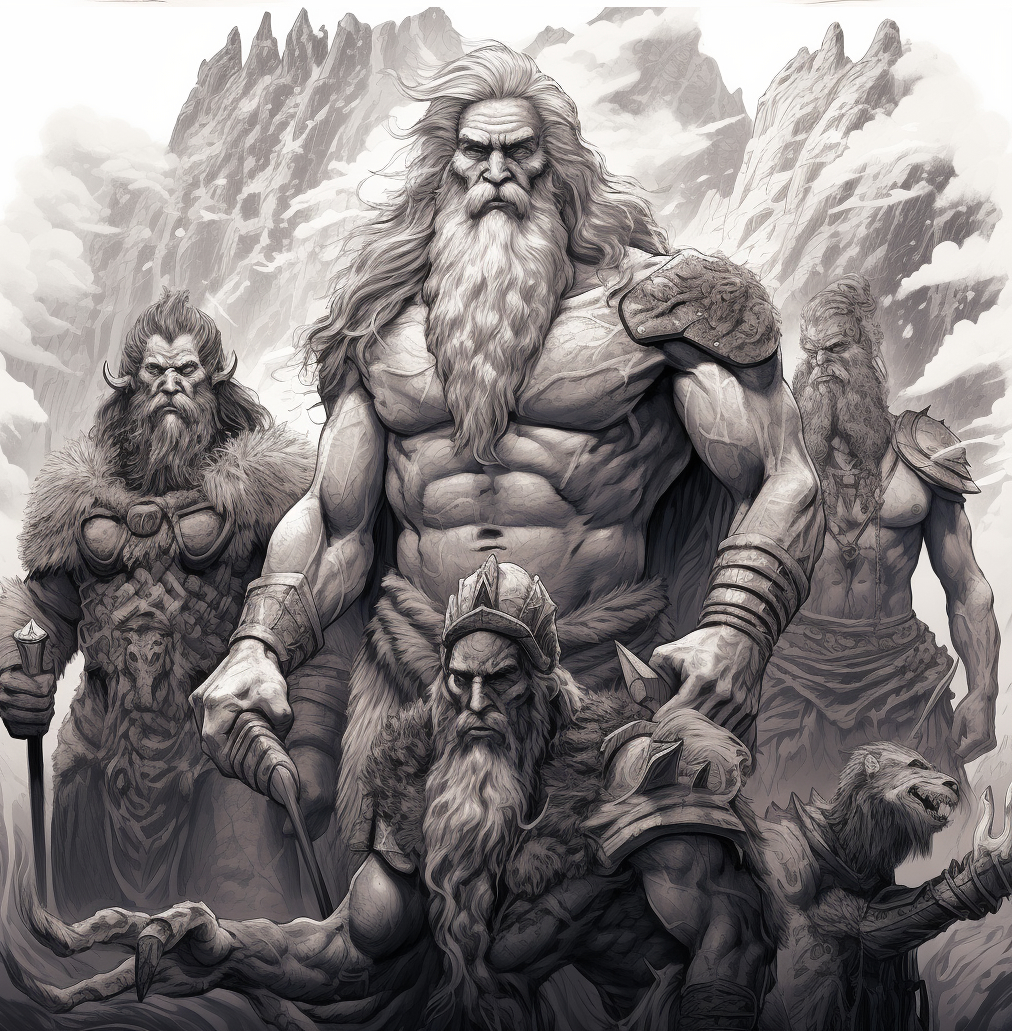
Die Hüne are the Titans and the Giants of both myths.  Primordial beings of great power that the gods defeated but still trouble them.  In this myth, the Gods fought Die Hüne and brought order out of chaos. These are not just giants and titans. These creatures are the demons of this mythology.  They are beings of primordial chaos. 

In my mind, they combine giant, elemental, and demon. The Gigantes of Greek myth (not AD&D) were more monstrous creatures.  The jötunn of Norse myth likewise were more demonic. As time passes, these titans and jötunn become more human-looking until we have something like the giants of D&D. 

My goal with Die Hüne is to return to those older, more monstrous giants. Given that this mythology is half-Roman, these people will have been familiar with some of the tales of Goliath, the Anakim, and others from Jewish mythology.  So maybe some of those tales entered into their thinking.

For these monsters I can use my write-ups for the Jötunn and my classifications of Die Hüne from previous posts.

Hüne Vater

Hüne Vater is the father of the current generation of the Gods. He killed his father and was, in turn defeated by his own son. He is the leader of Die Hüne. Before his defeat, he cursed the gods and all humankind with death. In Proto-Indo-European myths, he is the Archdemon.  He sits imprisoned in exile. 

This is a complex figure. He combines aspects of both the Roman Saturn and the Norse Surtr. He is the leader of the Primordial Chaos beings. If anything, he represents the future which is death. Surtr plays an important role in the Norse Ragnarök. Saturn/Chronus is often depicted as an old man with a scythe or sickle, an image that gives us both the anthropomorphized Father Time and Death. This why my Hüne Vater curses gods and mankind alike with old age and death. The gods have their apples to protect them. 

He is a destroyer. He killed his own father (Großvater) and impregnates his mother (Großmutter) to bring about the Hüne and the new generation of gods. He would also have aspects of Satan and Angra Mainyu. He is chaos, fire, and destruction. He wants nothing more than to destroy everything.

Die Hüne
HÜNE VATER (Primordial Titan)
Intermediate God

ARMOR CLASS: -7
MOVE: 36"
HIT POINTS: 300
NO. OF ATTACKS: 2
DAMAGE/ATTACK: 2d10/2d10 
SPECIAL ATTACKS: Aura of the Inferno
SPECIAL DEFENSES: Blinding Defense
MAGIC RESISTANCE: 75%

SIZE: L (25")
ALIGNMENT: Chaotic Evil
WORSHIPER'S ALIGN: Any Evil
SYMBOL: An open flame
PLANE: Hölle

CLERIC/DRUID: 5th level Druid
FIGHTER: 15th level Fighter (Barbarian)
MAGIC-USER/ILLUSIONIST: Nil
THIEF/ASSASSIN: Nil
MONK/BARD: Nil
WITCH/WARLOCK: Nil
PSIONIC ABILITY: II
S: 25 I: 14 W: 15 D: 18 C: 25 CH: 10

Hüne Vater is the father of the Hüne (Titans) and the first generation of Gods. He is chaos incarnate and is the element of fire. He lives only to destroy everything around him. He was defeated by the gods under the leadership of Unser Vater.  He is imprisoned in Hölle where he is guarded by the gods Hüter (Protector of the Dead) and Helga (The Ghost Queen), and a myriad of monsters. 

It is said that Hüne Vater created the sky and the Earth out of his parents, but this was not an intentional act of creation but one that happened due to his own destructive influences. Later Unser Vater would bring order to the universe.

If free from his prison, he can attack with two massive fists. He is surrounded by an aura of flame that can do 2d8 hp of damage to anyone within 60' of him.  Once every three turns, he can also fly into a berserker-like rage and make two additional attacks. 

Hüne Vater is not worshipped in the traditional sense. Berserkers call on him for their murderous rampage. He can be the patron for Chaotic Evil Warlocks. These warlocks are given access to any fire-based druid spell.

Großvater & Großmutter

Großvater and Großmutter are the names given to the quasi-anthropomorphic manifestation of the Father Sky and Mother Earth of the Die Hüne (the Titans/Jötunn).  Großvater was destroyed by his son Vater Hüne to make the night sky. Großmutter never fully recovered from her attack by Vater Hüne and is now still, but not dead. She ceded most of her power to her daughter Mutter Natur.

Links


RPG Blog Carnival

Friday, October 13, 2023

D&DGII The Black Forest Mythos: The Divine Twins

 This is really a fabulous October. We have five weekends, a full moon near Halloween, a Friday the Thirteenth (today) AND a total Solar Eclipse in some parts of the country tomorrow.  In celebration of tomorrow's solar/lunar event, I thought it would be good to discuss my God of the Sun and Goddess of the Moon, as well as other Divine Twins.

Jäger and Jägerin

The Divine Twins in the Black Forest Mythos

The motif of the Divine Twins is one that comes up again and again in most religions and myths. Usually they are the children of the main sky God, and they serve complimentary functions. Other twins are heroes who have many adventures with the gods.

Jäger and Jägerin

These gods are my syncretized versions of the Roman Apollo and Diana with the Norse Freyr and Freyja. They are the gods of the Sun and Moon respectively. Their names mean "Hunters" to help stress the importance that hunting, more than war, is to these people. They also see these gods as Nature gods, so sometimes they are depicted with stag horns.  Curious note. The Norse and Germanic peoples of this time measured time in "Nights" not days. So these combined gods are both the stewards of time.

When needed, Jägerin can don the armor of war and gather Die Kriegerin, the Goddesses of war (much like the Valkyries).  They are also the patrons of the arts bringing music and poetry to the people. 

When the moon eclipses the sun, it is said that Jägerin has put up her shield to protect her and her brother in battle. 

JÄGER (God of the Sun, Music, Hunting)
Intermediate God

ARMOR CLASS: 2
MOVE: 18" / 36"
HIT POINTS: 300
NO. OF ATTACKS: 3
DAMAGE/ATTACK: 2d8/2d8/2d8 + Fire
SPECIAL ATTACKS: Sunbolt
SPECIAL DEFENSES: Firey Aura
MAGIC RESISTANCE: 75%

SIZE: M (6' 2")
ALIGNMENT: Neutral Good
WORSHIPER'S ALIGN: All (mostly Good)
SYMBOL: Sun Disc or Bow
PLANE: Himmel

CLERIC/DRUID: 10th Level Druid
FIGHTER: 20th Level Fighter
MAGIC-USER/ILLUSIONIST: Nil
THIEF/ASSASSIN: Nil
MONK/BARD: Nil
WITCH/WARLOCK: Nil
PSIONIC ABILITY: II
S: 20 I:18 W: 18 D: 20 C: 20 CH:20

Jäger is the god of the Sun but is not the sun. He rides his chariot across the sky, searching for the best game to hunt. His tales of his hunting prowess are matched only by tales of his amorous exploits. He is married to Liebhaberin, but both gods are free to choose other lovers as they see fit. He is the model of youth in his prime.

As the god of the sun he can cast any light, fire, or sun-based spell as a 10th-level spell caster and spells he can cast as a 10th-level Druid. His main weapon is his bow. He can fire three arrows per round each hitting a different target. If he chooses, each (or any) arrow can burst into flame for an additional 1d8 points of damage. Additionally he can fire a Sunbolt for 1d10 points of damage. He can also wreathe himself in the Aura of the Sun. This causes Blindness to any that look at him and 1d8 hp of damage to any with 5' of him every round.

He is often accompanied by a group of deathless hunters. These are men who died while hunting or who wished not to move on to their afterlife after death. They hunt in ghostly processions across the land. Anytime a person sees a falling star, they know a new hunter has joined Jäger's ghostly party. Each acts as 10th level fighter and are similar to spectres.

Additionally, he is the god, or rather patron of, music. When not hunting, he can be found singing or playing an instrument.

Animal: The hunting dog or stag
Rainment: (Head) a solar disc or a crown of antlers (Body) Simple hunting garments
Color(s): Yellow, Gold
Holy Days: Every day at sunrise and noon
Sacrifices: Animal sacrifice at sunset. Animals are then eaten by congregants.
Place of Worship: Any open space.

JÄGERIN (Goddess of the Moon, Poetry, Hunting, War)
Intermediate Goddess

ARMOR CLASS: 2
MOVE: 18" / 36"
HIT POINTS: 300
NO. OF ATTACKS: 3
DAMAGE/ATTACK: 2d8/2d8/2d8 + Chill
SPECIAL ATTACKS: Moonbow
SPECIAL DEFENSES: Aura of Madness
MAGIC RESISTANCE: 75%

SIZE: M (6' 1")
ALIGNMENT: Chaotic Good
WORSHIPER'S ALIGN: All (mostly Good)
SYMBOL: Moon disc or Bow
PLANE: Himmel

CLERIC/DRUID: Nil
FIGHTER: 20th Level Fighter
MAGIC-USER/ILLUSIONIST: Nil
THIEF/ASSASSIN: Nil
MONK/BARD: Nil
WITCH/WARLOCK: 10th Level Witch
PSIONIC ABILITY: II
S: 20 I:18 W: 18 D: 20 C: 20 CH:20

Jägerin is the Goddess of Moon, hunting, poetry, and war. she drives her chariot across the sky as does her brother. On the days of the Solar eclipse she is holding up her shield to protect him. On days of the Lunar eclipse he is providing her protection.

Like her twin brother, Jägerin can attack with a bow. Her arrows do 2d8 and can also add an extra 1d8 hp of chill damage. She can surround herself with an Aura of Madness, any who come within 10' of her will attack anyone else but her.  She can cast any spell relating to night or the moon as a caster of the 10th level and as a 10th-level Witch.

Jägerin also has a retinue of hunters with her. These wild women will run through the forest with her in a blood lust for the hunt. They are not dead, but they are no longer alive either. Each acts as a 7th-level fighter and can transform into an animal. Wolves are most common. When needed though, she can call on her Hunt and don the armor of war. These wild women are then known as Die Kriegerin, or the Goddesses of War.

Like her brother, Jägerin is also the patroness of the arts, in this case poetry. She is equally as lascivious as her brother. One tale is told how she boasted she could hunt and kill as many animals as a group of men hunting in the wood. The all agreed to set out in the morning to hunt and return by night fall. Jägerin spent the night having sex with all the hunters and making them too tired to hunt the next day. She was able to go to the wood and hunt at her leisure, easily beating all of them.

Animal: The hunting dog or stag
Rainment: (Head) a moon disc or a crown of antlers (Body) Simple hunting garments
Color(s): Yellow, Gold
Holy Days: Every moonrise
Sacrifices: Animal sacrifice after sunset. Animals are then eaten by congregants.
Place of Worship: Any open space.

Siege and Glücke
Siege and Glücke

These are the Goddesses of Victory and Luck, respectively. 

SIEGE and GLÜCKE (Goddess of Victory and Luck)
Lesser Goddess

ARMOR CLASS: 4
MOVE: 18" / 36"
HIT POINTS: 150
NO. OF ATTACKS: 2
DAMAGE/ATTACK: 1d8/1d8
SPECIAL ATTACKS: Change Outcome
SPECIAL DEFENSES: Change Outcome
MAGIC RESISTANCE: 25%

SIZE: M (6' 0" and 5'19)
ALIGNMENT: Lawful Neutral (Siege) and Chaotic Neutral (Glücke)
WORSHIPER'S ALIGN: All
SYMBOL: Spear
PLANE: Himmel

CLERIC/DRUID: Nil
FIGHTER: 10th Level Fighter (Siege)
MAGIC-USER/ILLUSIONIST: Nil
THIEF/ASSASSIN: 10th Level Thief (Glücke)
MONK/BARD: Nil
WITCH/WARLOCK: Nil
PSIONIC ABILITY: II
S: 16 I:18 W: 18 D: 20 C: 18 CH:18

These goddess are not worshipped in the strictest sense, but are called on often enough to grant favors to mortals. Siege is the Goddess of Victory; she represents success through skill and determination. Glücke is the Goddess of Luck; she represents success through luck and happenstance. 

Both Goddess can offer a boon to a mortal in the form of gift of Success. Mortal with this gift can re-roll any missed attack, ability check or saving throw and take the better of the two rolls. Most mortal only get this gift once in their lives. Others, such as the hero twins Magni and Muthi, get this boon often. 

Magni and Muthi
Magni and Muthi

Magni and Muth are the Demigod hero twins of this myth. They are two fun and adventure-loving brothers whose tales are often used to teach moral lessons but also entertain. They typically begin with the brothers getting kicked out of their home because their mother (usually described as a hideously ugly witch but also described as the best cook in the world) is tired of them breaking things. The brothers devise a scheme to either get rich, get drunk, or find some maiden to bed. They often run afoul of some person in power, a barkeep, angry husband, father, and/or brothers. The more they try to solve their problems, the more (comical) trouble they get into. Magni is the Strongest Man alive, and there is nothing he can't lift or break. Muthi is the Bravest Warrior known, and he fears nothing, no man, demon, or god. Their tales will sometimes emphasize how much Magni is afraid of something or how something is too heavy for Muthi.

In the end, the brothers usually come out ahead. They get the money, the ale, and the girls and will be seen headed home, where their mother has made them a fantastic meal. They are mischievous but rarely evil. They only kill monsters and prefer to make fools out of human or divine opponents. 

It is said they are deeply in love with Siege and Glücke, but can't make up their minds about who is in love with whom.  

The only time the brothers fight each other is when they have their eyes on the same woman. And in these tales, the moral is always the same. While fighting each other, they lose the girl to someone else, and they return home to a scolding by their mother.

MAGNI and MUTHI
Demigods

ARMOR CLASS: 4
MOVE: 12" 
HIT POINTS: 110 (Magni), 120 (Muthi)
NO. OF ATTACKS: 3
DAMAGE/ATTACK: 1d10/1d10/1d10
SPECIAL ATTACKS: Nil
SPECIAL DEFENSES: Nil
MAGIC RESISTANCE: Nil

SIZE: M (6' 1" Magni) (5' 11" Muthi)
ALIGNMENT: Chaotic Good
WORSHIPER'S ALIGN: NA
SYMBOL: NA
PLANE: Erde (Earth)

CLERIC/DRUID: Nil
FIGHTER: 18th Level Fighter (Barbarian)
MAGIC-USER/ILLUSIONIST: Nil
THIEF/ASSASSIN: 10th Level Thief
MONK/BARD: Nil
WITCH/WARLOCK: Nil
PSIONIC ABILITY: Nil
S: 25 (Magni) 18 (Muthi) I:10 W: 8 D: 18 C: 20 (Magni) 25 (Muthi) CH: 19

Magni and Muthi are twin brothers. They are not worshipped in the traditional sense but are demi-god heroes of these myths, and their stories are told to children (about how they fight monsters) to adults (how they stop evil people and their sexual exploits). 

Magni can add +7 to his to hit and damage rolls due to his strength. Muthi is unaffected by any sort of fear, mundane or magical. This also extends to giving him +3 against any save vs. magic.

Characters encountering Magni and Muthi will often find them "mid-scheme." That is whatever it was they were trying to do has already failed spectacularly, and now they are either running from the authorities or an angry husband/father/brother. 

--

Links


RPG Blog Carnival